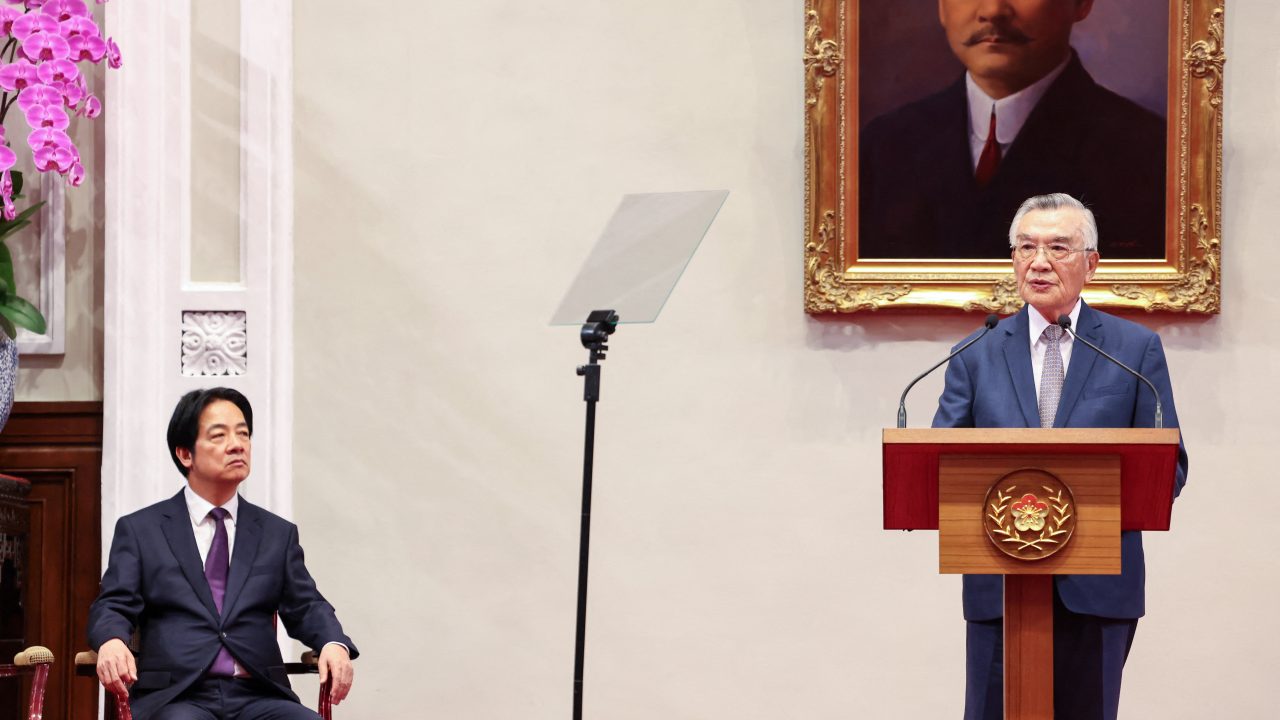
Taiwanese Foreign Minister Lin Chia-lung (林佳龍) visited New York in September, the same week as the United Nations General Assembly.
Lin’s full itinerary is unknown, but he attended an afterparty hosted by American Global Strategies, a strategic advisory firm co-founded by former U.S. National Security Advisor Robert O’Brien, who hand-delivered a letter from Taiwanese President Lai ching-te (賴清德) to U.S. President Donald Trump after his election victory.
A CNN report that multiple senior U.S. officials were expected to attend but ultimately didn’t subsequently caused a stir in Taiwanese media. Politico had previously reported the presence of U.N. Ambassador Mike Waltz and other U.S. and foreign officials. Ethan Tu (杜奕瑾), the founder of Taiwanese online bulletin board PTT, then produced a photo on social media of Lin standing next to Waltz and O’Brien at the event.
Lin’s presence in New York during the assembly is understood to be a first for a Taiwanese foreign minister. Prior to his arrival, the foreign minister published an op-ed in conservative news outlet Newsmax arguing that the U.N. should allow Taiwan to join, which was seen as an effort to connect with Trump supporters.
Taiwan’s busy foreign minister also made two trips to Europe.
Starting from September 11, Lin made a four-country tour starting in Prague and moving through the Netherlands, Italy and Austria. Lin visited the Taiwanese embassy to the Vatican City, the only European country that recognizes Taiwan, but seemingly did not enter the Holy See itself.
In Prague, Lin and other Taiwanese politicians attended the opening of an exhibition of Taiwan’s National Palace Museum artefacts at the National Museum of the Czech Republic, which had been years in the making. Lin’s trip to the Netherlands was kept secret until the story was broken by Domino Theory.
On September 27, Lin returned to Europe and gave a speech at the Warsaw Security Forum. He was accompanied by Lieutenant General Hsieh Jih-sheng (謝日升), the deputy chief of the general staff for intelligence, who made a panel appearance in full uniform. (Taiwanese military figures often wear civilian clothes abroad even in official contexts to avoid the perception their host recognises Taiwan.)
Lin reportedly also visited France during one of these two trips.
At the beginning of September, a Taiwanese defense delegation signed a memorandum of understanding with Polish and Ukrainian counterparts to cooperate on drones.
That memorandum was in evidence at the Taipei Aerospace & Defense Technology Exhibition later in the month where the Polish pavilion was displaying the flags of the three cooperating countries.
Taiwan has been pushing to develop its domestic drone industry, opening a new industrial park in Chiayi. The government has committed to purchasing 50,000 UAVs for military use over the next two years.
Part of the strategy is also to make Taiwan a part of international “China-free” or “non-red” drone supply chains, leveraging the fact that countries see geopolitical risk in making their defense industries dependent on Chinese parts. In October, a Taiwan–EU Drone Technology and Export Forum was held in Taipei, promoting further cooperation.
At the end of the Pacific Islands Forum in September, member states reaffirmed Taiwan’s status as a “development partner.”
Unusually, partner countries like Taiwan, China and the U.S. did not attend the forum, which was this year held in the Solomon Islands, increasingly a Chinese ally.
It is broadly understood, as detailed in this Global Taiwan Institute brief, that the Solomon Islands attempted to exclude Taiwan at China’s behest, and when this received too much pushback from other countries, all external state partners were excluded.
Three of the remaining 12 countries that recognize Taiwan are Pacific Island states. The Solomon Islands itself only switched to recognize China in 2019.
Taiwan hosted the first ever visit by an American Israel Public Affairs Committee, or AIPAC, delegation at the end of October.
AIPAC is a pro-Israel lobbying group in the U.S. President Lai told the visitors that Israel is a model for Taiwan to learn from in strengthening its defences, according to Reuters.
Taiwan has increased its relations with Israel since the October 7 attacks and the start of the Gaza War. This week, Foreign Minister Lin defended Taiwan’s outreach to Israel when talking with foreign journalists, saying “Palestine is very bad to Taiwan.”
A group from the Israel-Taiwan parliamentary friendship group visited Taiwan in September and met with Lai, led by chair Boaz Toporovsky. Toporovsky had in July spearheaded an effort in Israel’s parliament to pass a declaration condemning Taiwan’s exclusion from international fora.
China belatedly suggested that Taiwan’s participation in APEC 2026 will be dependent on its adherence to the one-China principle.
The APEC leaders’ summit will be held in Shenzhen next year. A U.S. State Department spokesperson said that China affirmed “the full and equal participation of all APEC member economies — including Taiwan, referred to as Chinese Taipei in APEC — consistent with APEC’s guidelines, rules and established practice,” when the summit was allotted in 2024.
China’s Taiwan Affairs Office stated that Taiwan should participate as Zhongguo Taipei (中國台北) but Foreign Minister Lin told media: “In APEC’s own membership listings, it’s officially ‘Zhonghua Taipei (中華台北).’ Both phrases translate into English as “Chinese Taipei,” but China’s preferred version means “Chinese” as in “pertaining to the state of China,” whereas the wording Taiwan actually operates under internationally means “culturally Chinese.” At the 2022 Beijing Winter Olympics, Taiwan’s preferred Zhonghua Taipei was used.
Taiwan sends a representative to APEC rather than the national leader. In recent years, this has been Lin Hsin-i (林信義), a former vice premier and economic minister.
President Trump did not discuss Taiwan with Chinese President Xi Jinping (習近平).
Much ink was spilt in the run-up to Trump’s meeting with Xi on the sidelines of last month’s APEC summit in South Korea on whether or not he would sell out or sign away Taiwan. The speculation resurfaced the already tense rift between the “primacists,” who want to preserve American power and commitments in Asia, and the “restrainers,” who want to withdraw to the Western Hemisphere.
In the end, Taiwan was not on the table, and the meeting seems to have, at least temporarily, lowered the temperature in U.S.-China relations. Whether that is good news for Taiwan itself is debatable, but Trump did produce this killer quote on the way to the meeting:
“There’s not that much to ask about. Taiwan is Taiwan.”




Leave a Reply