Before Saturday’s elections, we asked various experts what to look out for when the results were released. They painted a more layered picture of what mattered than simply who would win the presidency. Now, with the dust settling on the results, those layers are even more apparent.
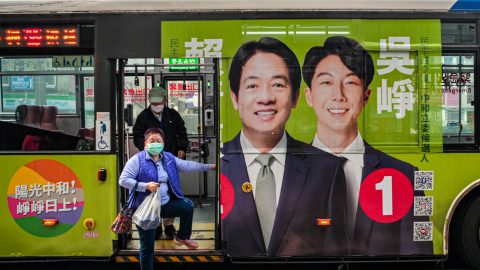
As many predicted based on polling data, Democratic Progressive Party (DPP) presidential candidate Lai Ching-te (賴清德) won the presidential vote with 40.05 percent of the total, short of an absolute majority. Ben Goren, co-founder and director of communications at the Taiwan Policy Centre, suggested this could mean Lai will have less “political capital,” and as soon as the election results came in there were early signs of that being the case.
Within Taiwan, there have already been calls for Lai “compromise” from some media outlets. Meanwhile, commentators such as Paul Huang, Research Fellow at Taiwan Public Opinion Foundation, immediately framed Lai as a “minority president whose victory is the result of oppositions divided rather than… the support of [an] absolute majority.”
Most dramatically, China has already sought to use the lack of absolute majority in its favor. Its Taiwan Affairs Office said “The results of the two elections in Taiwan show that the Democratic Progressive Party [DPP] cannot represent the mainstream public opinion on the island.”
The other election that statement referred to was the legislative election. And there, too, below-the-surface issues predicted by experts have already begun to play out.
On Saturday, the DPP won the presidency but no majority in Taiwan’s Legislative Yuan. It secured 51 seats, the Chinese Nationalist Party (KMT) 52, and the Taiwan People’s Party (TPP) eight, with KMT-leaning independent candidates winning two seats. Sara Newland, assistant professor of government at Smith College, told Domino Theory last week that in such a situation the president “may have a difficult time pushing through their agenda, particularly on issues on which the parties’ positions strongly diverge (e.g. cross-strait policy).”
That possibility immediately became concrete when Lai spoke after his victory.
At his international press conference, he said that as a result of not winning a legislative majority, he would be prepared to include beneficial policies from other parties into his “policy framework.” He also said that his political appointments would “act in accordance with the spirit of a democratic alliance by bringing in talent from different political parties.” And he added that he would “prioritize issues that have consensus between political parties” and “work to set aside differences while maintaining clear lines of communication” on issues where there was no consensus.
Ko Wen-je (柯文哲) of the Taiwan’s People’s Party (TPP) believes his party will be a significant beneficiary from that situation, saying on Saturday that the TPP would become a “critical minority” in Taiwan’s legislature. However, the future of him and his party is itself a further layer of the results that requires unpicking.
“If the candidates from the TPP perform well (perhaps outperforming Ko), that could give us some clues about whether the TPP is likely to remain a force in Taiwan’s politics in the future,” Newland told Domino Theory before the election. But while some have called the TPP winning 22.07 percent of the party-list vote and eight seats a “decent platform to build on,” others have pointed out that support for Ko does not translate one-to-one to support for the TPP. Ko himself received 26.46 percent of the presidential vote, justifying for some the idea he is a “one man party.”
For Newland, the result “points to the fact that there’s still more support for him as an individual [than] as a party.” Ironically, though, she notes by email that Ko is now “going to be less important, and maybe less visible in day-to-day politics, than the most important TPP legislators (Huang Kuo-Chang [黃國昌] and Huang Shan-shan [黃珊珊]). So it’s possible there will be some significant growing pains for the TPP as it tries to transition from a focus on Ko to trying to be a major player in the legislature.”
While that debate continues, there are smaller scale currents that remain important, too.
Speaking via email the day before the election, Rita Jhang (張竹芩), a board member at the North American Taiwan Studies Association, said it was likely none of the smaller parties in Taiwan, such as the Taiwan State Building Party and the New Power Party, which emerged out of the Sunflower Movement, would win any seats in the legislature. “If that’s the case,” she said, “it signals the end of the Sunflower Movement generation [and] heralds a difficult decade to come for civic actions.”
This prediction came to fruition. In the final results, no smaller parties won any seats on Saturday, and many younger candidates who emerged from the Sunflower Movement lost. New Bloom Magazine noted that the DPP’s Tseng Po-yu (曾柏瑜), Wu Cheng (吳崢), Tseng Wen-hsueh (曾玟學) and Lai Pin-yu (賴品妤) all lost, as did DPP-backed Miao Poya (苗博雅).
Jhang’s view was that this “may also set the stage for a new generation to emerge.” This is the optimistic way to view a political environment featuring a legislature that will have an average age of almost 53 years old, in which the “third party” soaking up the rebellious political energy is actually the one with the oldest average age, at almost 58.
Photo: I-Hwa Cheng/AFP




Leave a Reply