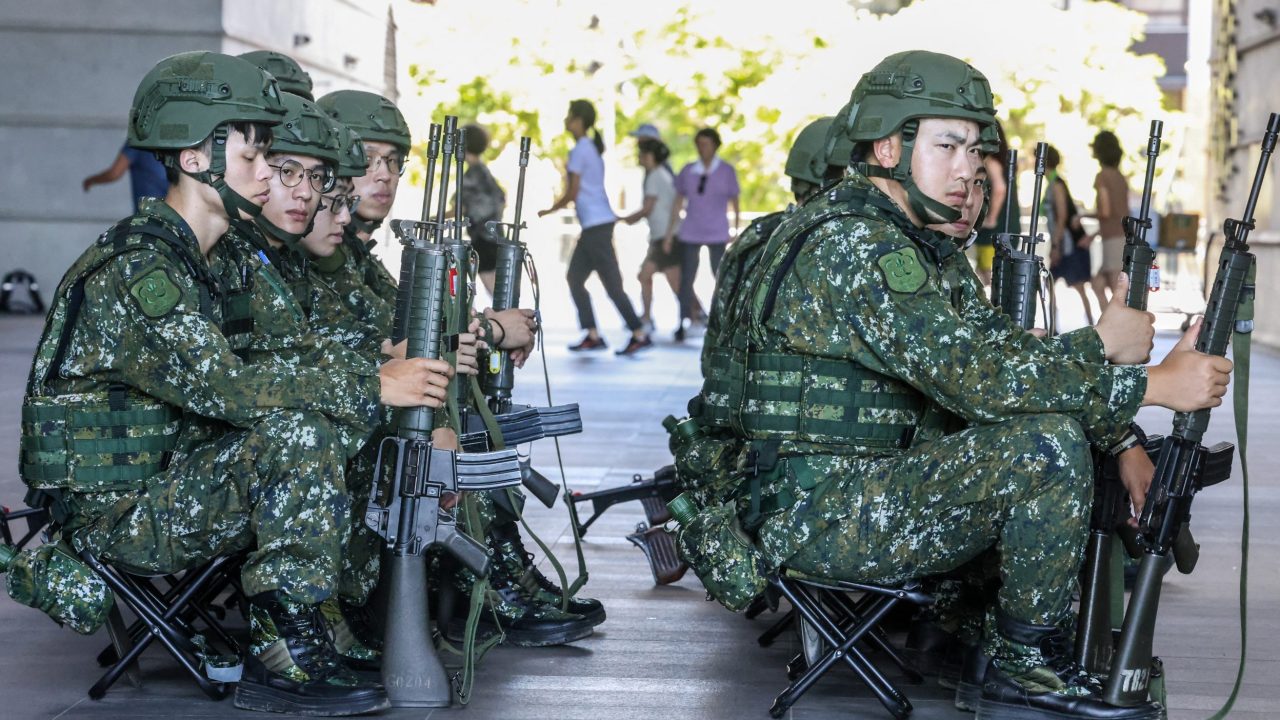
The parliament of Taiwan has finished, almost, unfreezing the portion of the defense budget it froze in February of this year.
The Legislative Yuan had frozen about 14% of Taiwan’s planned 2025 military spending, with operational costs particularly hard hit.
That move took place among a much wider set of budgetary freezes and cuts, which in turn was a part of an ongoing political struggle between the legislative and executive branches, which are controlled by different parties. It had been unclear whether the “freezes” were really going to be reversible, or were in fact stealth cuts.
Now, with the exception of a single budget item related to the ongoing development of Taiwan’s indigenous submarine program, the money has been released.
Has the period where the defense budget was frozen hurt Taiwan? “I think we can manage this, [it’s] three to four months,” said Chen Kuan-Ting (陳冠廷), a Democratic Progressive Party (DPP) legislator who sits on the Foreign Affairs and National Defense Committee responsible for the unfreezing.
The Legislative Yuan froze 90 billion New Taiwan dollars ($3.1 billion at today’s exchange rate) of 2025’s proposed defense spending in February, in addition to cutting NTD 8.4 billion. 279 individual spending items were frozen. Over the course of three meetings of the defense committee, 278 of them have been unfrozen, with the last 40 being completed yesterday, according to Chen Yeong-kang (陳永康), a Chinese Nationalist Party (KMT) legislator who is also on the defense committee.
The remaining item, spending related to Taiwan’s indigenous submarine program, will be unfrozen upon completion of the first submarine’s sea trials in September, Chen Yeong-kang’s staff explained in a private budget presentation to Domino Theory.
Part of the submarine budget is still available before September to allow CSBC Corporation, the shipyard responsible for the construction of the future submarines, to sign necessary contracts.
Both KMT and DPP legislators confirmed with Domino Theory that the specific delay to the unfreezing of the submarine funding has been negotiated with Taiwan’s Ministry of National Defense.
Chen Yeong-kang of the KMT outlined the unfreezing process. For each item that had been frozen, a written or verbal report was submitted to the defense committee explaining and justifying the necessity of that spending. Only rarely, as in the case of the purchase of uncrewed aerial vehicles (UAVs) by the army, was an actual reduction in spending requested and negotiated with the defense ministry.
Sitting in front of a white board explaining the many missiles in service with Taiwan’s armed forces, Chen Kuan-Ting of the DPP pointed out that in his own constituency he had had to fight against cuts in spending on the Minxiong Aerospace Park, a part of Taiwan’s plan to develop a domestic UAV industry. Those cuts became one of the frozen items instead and Chen said unfreezing it had required a report to be submitted and “nothing” else.
Chen Kuan-Ting said the performance of the committee on dealing with unfreezing of the budget had “changed dramatically in the past two three months,” which he attributed to the recall processes that are dominating Taiwan’s domestic politics this summer. “Sometimes freezing the budget could be rational,” he said, and gave examples of higher costs, or government efficiencies. “But when you [freeze] all the weapon systems, or all the budget,” Chen suggested “there is suspicion of potential Chinese Communist Party influence on this.”
Unsurprisingly, his political opponents disagree. Taiwan People’s Party (TPP) legislator and defense committee member Lin Yi-chun (林憶君) provided Domino Theory with an emailed statement: “The situation is not as the Democratic Progressive Party (DPP) has portrayed. In fact, both Kuomintang (KMT) and Taiwan People’s Party (TPP) legislators agreed to unfreeze the budgets. There was no attempt to block the defense budget.”
Taiwan’s allies, particularly the U.S., will likely be relieved the money is flowing again. The freeze had often been characterized as a cut by the media, including Domino Theory. U.S. senators had openly criticized the “dangerous games” they said the opposition in Taiwan was playing with the defense budget. The KMT has sent several delegations to Washington to explain the party’s national security strategy, and has always insisted that it supports increased defense spending.
Defense budget questions are not over for Taiwan. According to numbers provided to Domino Theory by the KMT’s Chen Yeong-kang, defense spending for 2025 is now at 2.38% of GDP. In February, almost simultaneously with the announcement of the freezes, President Lai Ching-te (賴清德) made a public commitment to spend 3% of GDP on the military this year. Both U.S. President Donald Trump and his undersecretary of defense for policy, Elbridge Colby, have called for Taiwan to spend 10%.
That could only be done using the so-called special budget mechanism, which means the Legislative Yuan would once again come to the fore as the parliament would have to pass this. It seems unclear whether this would even be contemplated before the recall process is finished, given that some legislators could be recalled and replaced, but the DPP’s Chen Kuan-Ting told Domino Theory he expected it to be discussed “very soon.”


Leave a Reply