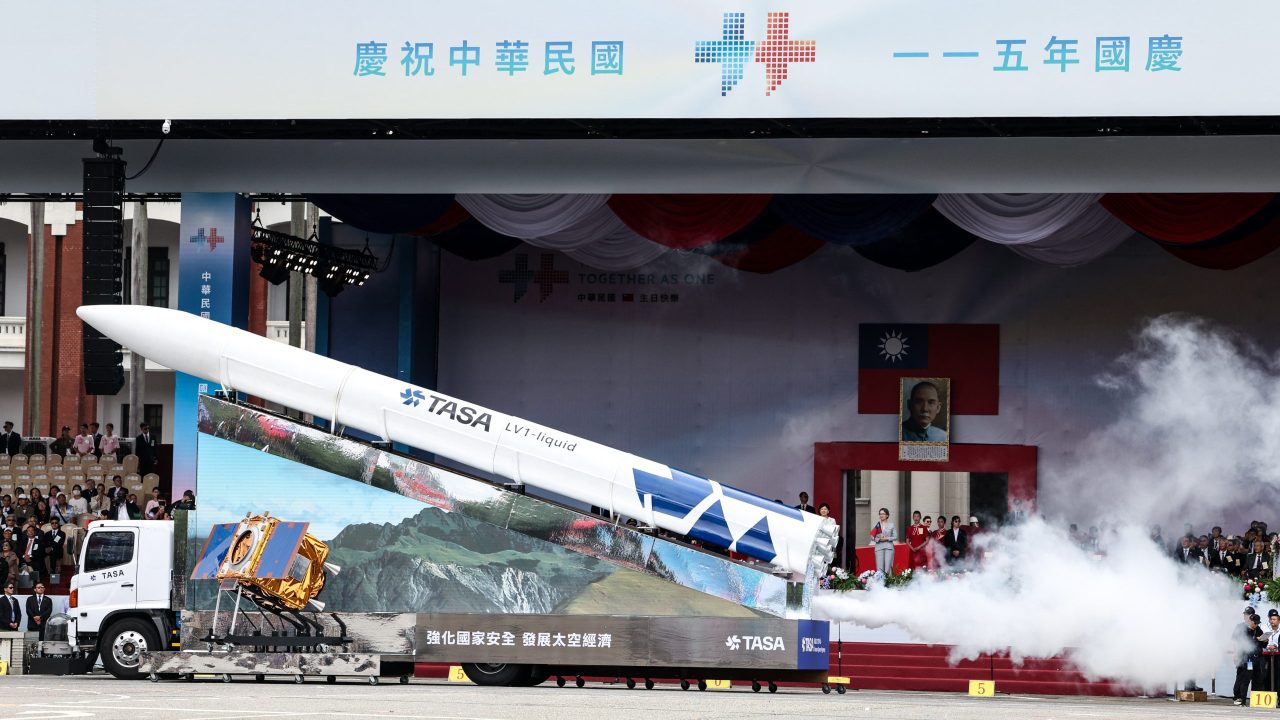
Taiwan has changed course on its program to build its first domestic launch vehicle.
The system was initially planned to have an unconventional hybrid rocket engine. Now, TASA, the Taiwan Space Agency, has switched to a more powerful liquid rocket engine design similar to those used by most other nations. This appears to have pushed flight tests back four years, to 2034.
Even though the change may add challenges, the agency expects short-term and long-term benefits from the move.
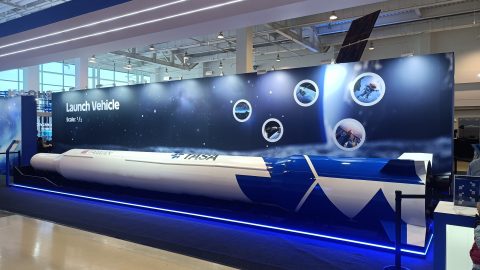
TASA displayed a mock-up of the vehicle this week at the Taiwan International Assembly of Space Science, Technology and Industry expo, commonly known as TASTI.
“There will be some limits of the payload capability [of the hybrid rocket],” said Jhen-Wei Huang (黃振瑋), an engineer from the rocket program. “If we are going to use this engine and the rocket in the future, then we decided to convert to the liquid solution earlier.”
The majority of orbital launch vehicles today and historically use liquid rocket engines, where both the fuel itself and the oxidizer are in liquid form. By contrast, a hybrid engine has solid fuel and a liquid oxidizer.
Although hybrid rockets have seen some success in limited applications, there has never been a successful orbital launch using the technology.
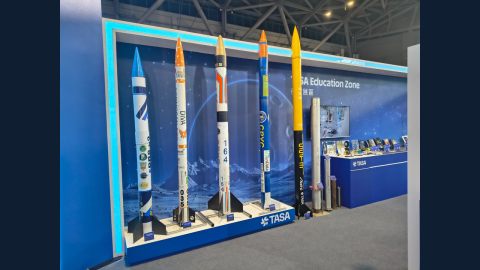
When Taiwan started development of its first domestic launch vehicle, it chose hybrid rocket technology because most of the smaller Taiwanese rockets developed by universities are hybrids, and TASA wanted to leverage this civilian expertise. None of these existing vehicles are large enough to reach orbit.

The first stage of the planned rocket, which is currently named LV-1 Liquid, will be powered by nine liquid rocket engines. The second stage will have a single engine of the same design, with the nozzle adapted to be more efficient in the vacuum of space.
The fuel will be kerosene, with liquid oxygen as the oxidizer, a common mix known as kerolox. TASA chose kerolox because there is a lot more literature on it compared to other options like liquid methane or liquid hydrogen, which have grown in popularity because they are more efficient.
The materials science and manufacturing of the new engine is expected to be the biggest challenge during the development phase, Huang said.
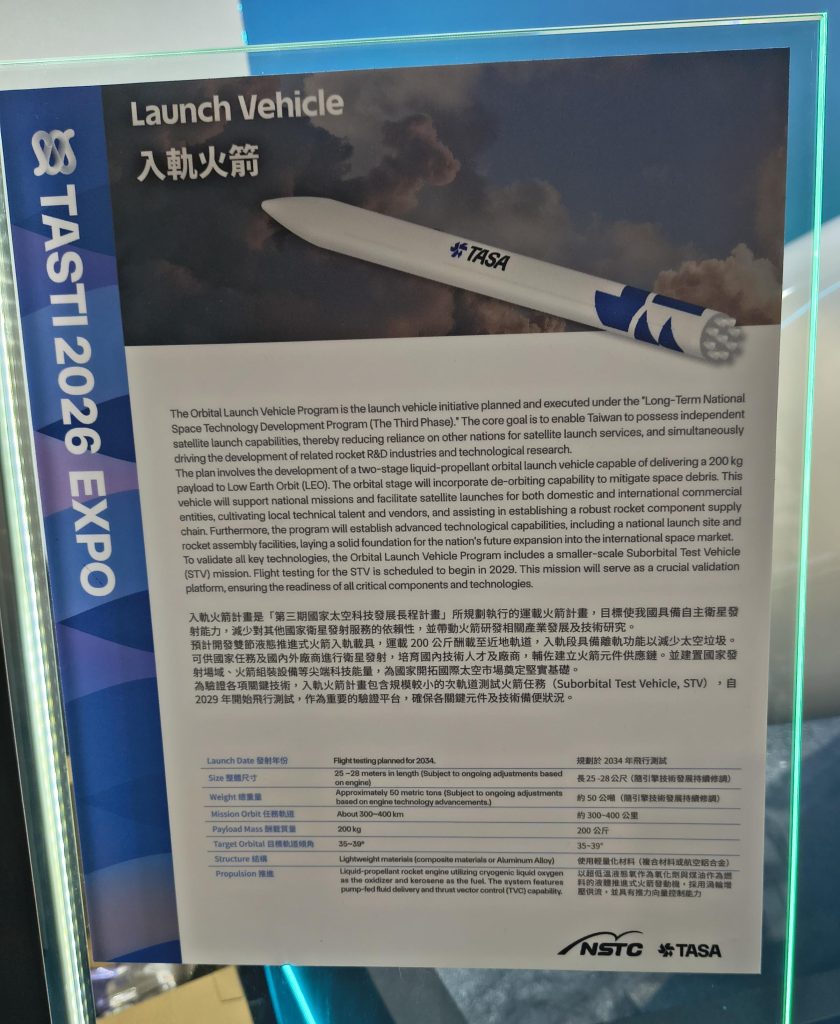
The new launch vehicle design will be 25 to 28 meters tall, with a fueled mass of approximately 50 tons, subject to the finalization of the design. It will be capable of launching 200 kilograms into low earth orbit. TASA stated on social media site Threads that its research showed the hybrid design would be unable to lift 200 kilograms to orbit.
This intended payload capability puts the launch vehicle firmly at the bottom of the market, as a small-lift launch vehicle. By comparison, SpaceX’s Falcon 9, the most successful rocket of all time, can lift 22 tons in its most powerful configuration.
There is still a market for small-lift, as evidenced by the success of Rocket Lab’s Electron. But for Taiwan, the most obvious problem is that it wants the sovereign capability to launch its own satellites. Mock-ups of Taiwan’s various weather, earth observation and communication satellites were also on display at TASTI. Most of them have weights in excess of 400 kilograms, so the new rocket initially would not be able to launch them.
“We will try to improve our engine or the structure,” Huang said, when asked about this. Another TASA engineer who asked to remain anonymous was optimistic, pointing out that the Firefly Alpha rocket has very similar dimensions but is able to lift 1,000 kilograms to orbit. “Better engine, better performance,” they said.
But even if the switch to liquid engines will bring long term benefits, there are signs that the cost is being paid up front. In 2024, TASA said the hybrid launcher was due to start flight testing in 2030. The sign at TASTI this week said 2034.




Leave a Reply