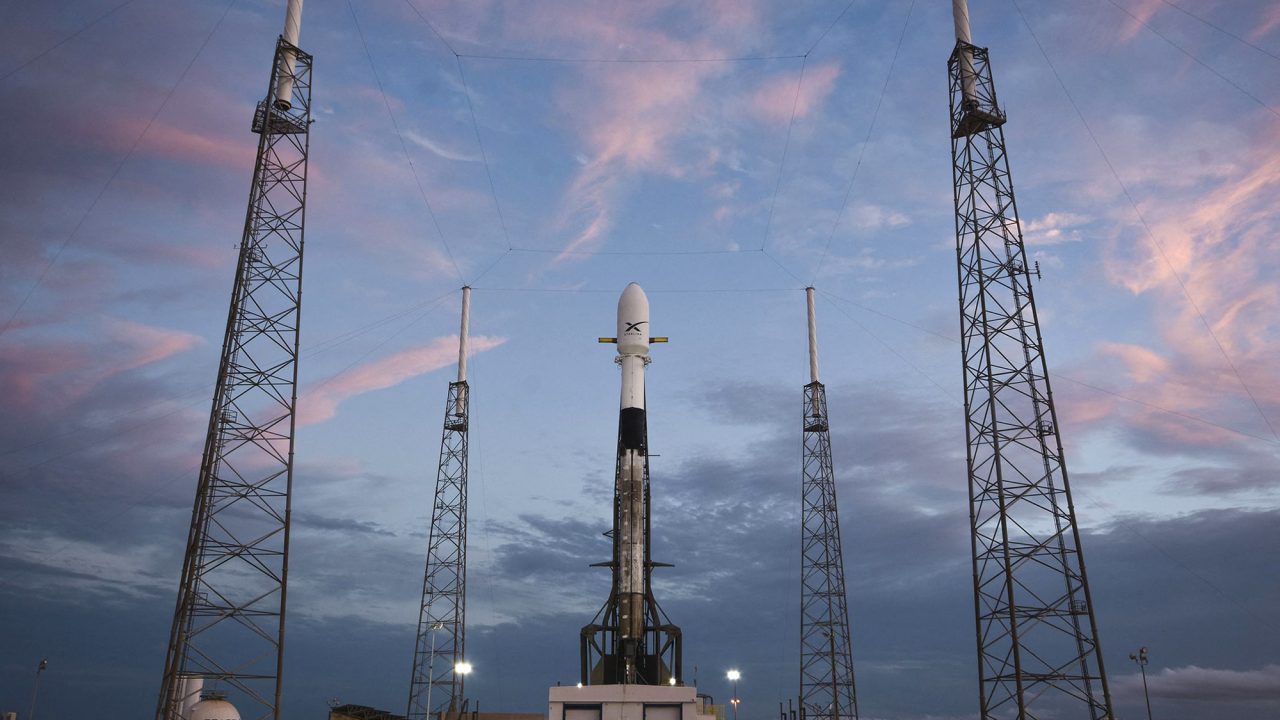
On Friday, if there aren’t any more delays, Taiwanese company Tron Future will launch its first satellite into low-Earth orbit. Tron Future said in a press release last week that the Bellbird-1’s (鐘雀1號) maiden flight would test its high-speed broadband communications payload.
Tron Future developed the Bellbird-1 under a startup scheme that Taiwan’s space agency, TASA, started three years ago to encourage domestic firms to break into the space market. Jong-Shinn Wu (吳宗信), TASA’s director general, has touted the program as a much-needed backup layer for Taiwan’s fragile digital infrastructure. In July, the director of the program, Chia-Ray Chen (陳嘉瑞), said that TASA chooses partners based on their potential for commercial application.
But according to a person who works at Tron Future, who requested anonymity to discuss sensitive matters, the Bellbird-1 was also designed with a military application in mind: controlling drone swarms.
“It is best to speak directly with Tron Future,” a TASA spokesperson said when I asked her to comment on this information. “The application of the CubeSat is up to Tron Future.” The Bellbird-1 is an 8U CubeSat, a low-cost class of satellite that is small and standardized. “I think it might be a little sensitive if TASA comments or replies to the questions. I hope you can understand,” the TASA spokesperson added.
Tron Future is a defense and aerospace firm based in Hsinchu. In addition to satellites, it makes an AI-powered anti-drone system that the company has already installed in more than a dozen locations around Taiwan.
The company was founded in 2018. Its leadership team is stacked with PhDs and professorships from Taiwan’s top technical schools. But Tron Future doesn’t just want to be the local champion: It has global ambitions. At a major defense expo in September, Tron Future’s CEO, Yu-Jiu Wang (王毓駒), signed agreements with defense manufacturers from Vietnam, Sweden, India and South Korea, among others.
“The white bellbird has the call with the highest decibel level in the world, symbolizing good communication quality, hence the name,” TASA explained in a press release this summer.
According to the Tron Future employee, the Bellbird-1 will deliver data transmission rates of 100 megabits per second, sub-100-millisecond handover mechanisms, beam-hopping switching times within 1 millisecond, and inter-satellite links achieving speeds above 1 megabits per second.
When he fed me these numbers last week, I was confused. He seemed a bit confused, too, but he suggested I talk to Richard Chou (周宇平), former director of planning for Taiwan’s Air Defense Missile Command.
Chou pointed out that ground-based terminals can only communicate with a drone when there is a direct line of sight between them — at a certain distance, the Earth’s curvature gets in the way. “Tron Future’s handover and beam-hopping technologies significantly improve this problem, allowing UAVs to operate remotely simply by connecting to low-Earth orbit satellites,” he said.
The handover mechanism helps low-Earth orbit satellites overcome another limitation. At several hundred miles off the ground, each Bellbird-1 will only be able to connect objects within a circle roughly 40 miles across. For users to control a drone swarm outside of that range, the system passes the signal from one satellite to the next, hopping along the constellation before beaming the data back down to Earth. For the system to cover Taiwan and its outlying islands, Tron Future is going to have to launch a lot more Bellbirds. At least 70, Chou estimates.
Controlling drone swarms via satellite is one way of evading devices that interfere with a drone’s communications, called jammers. Because satellite constellations are in constant motion, they can be more difficult to jam than stationary ground terminals. According to the Tron Future employee, the Bellbird-1’s beam-hopping and handover mechanisms would make a constellation of the satellites even more difficult for jammers to lock on to.
When I sent the satellite’s specs to Yuster Yu (于孝斌), a retired commander in Taiwan’s navy who now works as a cybersecurity consultant, he wasn’t impressed. “Bottom line, none of this tech is novel,” he said. “These systems are a dime [a] dozen in Europe, U.S., etc., and China has the same, they will know how to degrade it.”
Yu said that China has become so good at destroying and disabling satellites that Taiwanese efforts to build a jam-proof model are a waste of time. And he thinks the ground stations that link up with the satellites would be vulnerable to attack, too. “Deploying another system that is just as vulnerable as undersea cables will not make Taiwan’s wartime communications more resilient,” he said.
Taiwan’s internet connectivity relies almost entirely on a network of undersea cables that many fear China would cut during an invasion. In its war with Russia, Ukraine has transferred much of its military communications to Starlink, Elon Musk’s world-beating satellite internet service.
In a paper published in the journal Systems Engineering and Electronics earlier this month, a team of Chinese researchers from Zhejiang University and the Beijing Institute of Technology concluded that jamming Starlink’s system over an area the size of Taiwan is technically feasible. But it would be incredibly difficult — requiring more than 900 synchronized airborne platforms.
Taiwan’s government has held talks with SpaceX, the company that makes Starlink, in the past. But negotiations broke down over Taiwan’s requirement that foreign entities involved in communications infrastructure form a joint venture with a local partner that would maintain a majority stake. Taiwan’s government has since searched for alternatives, invested in its own satellite capabilities and incentivized local companies to get involved.
Tron Future’s Bellbird-1 is slated to lift off from a launchpad in California, where a SpaceX Falcon 9 rocket will carry it into low-Earth orbit. Joining it on the flight — alongside TASA’s flagship Formosat-8A — are two other satellites produced by private companies under the TASA startup program.
In June, Taiwan’s National Science and Technology Council, which oversees TASA, said that it hopes the startup program will eventually yield two domestic satellite communications manufacturers.
Friday’s launch is just the first stage in Tron Future’s plans. In March, it plans to send up another Bellbird-1, with two more to follow in June. Getting enough satellites into orbit to cover Taiwan — not to mention the area where it might deploy attack drones in a war with China — will take years.
When I asked the TASA spokesperson how much the government had invested in Tron Future’s satellite, she declined to say. I also wanted to know how much oversight TASA maintains over the development of Tron Future’s satellites, but she was struggling a bit in English. I suggested she send me a written statement in Chinese instead. “I just got told by my supervisor that I can’t reply to you in words,” she said.
I decided to try spoken Chinese. “Collaborate on development and then let them use their CubeSat freely?” I suggested. “I wouldn’t say ‘use freely,’” she replied. “We assist them on anything related to space technology.”






Leave a Reply