
Semiconductors
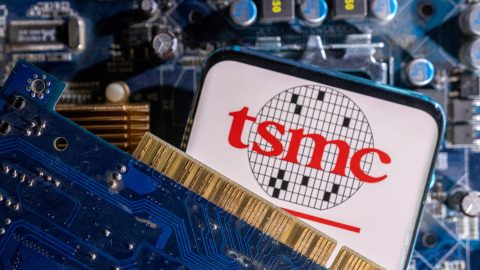
Taiwan Semiconductor Manufacturing Co.’s stock price reached a record high on the New York stock exchange last week. “TSMC shares are up 82% this year amid continued investor enthusiasm for artificial intelligence trades,” Bloomberg noted.
TSMC’s new Japanese plant is set to start mass production in the new year, according to the president of the local operating unit, Yuichi Horita. He also said the fab aims to procure 60 percent of equipment and materials from Japanese suppliers.
As previously speculated, TSMC’s Arizona fab is set to begin mass manufacturing four nanometer chips this year. The chip can be used in Nvidia’s most advanced GPUs.
TSMC has also announced plans to build two additional chip plants in the Taiwanese city of Kaohsiung. They aim for them to be operational in 2027.
U.S. president-elect Donald Trump’s pick for undersecretary of defense policy, Elbridge Colby, has repeatedly called for TSMC to be disabled or destroyed should China invade Taiwan. “Disabling or destroying TSMC is table stakes if China is taking over Taiwan,” Colby wrote on X earlier this year. “Would we be so insane as to allow the world’s key semiconductor company fall untouched into the hands of an aggressive PRC?” he asked.
Nvidia CEO Jensen Huang (黃仁勳) publicly named Nvidia’s supply chain partners in Taiwan for the first time last month, according to local media. Semiconductor packaging and testing firm Siliconware Precision (一厂) and testing firm King Yuan Electronics Co. (京元電子) were among those named.
Separately, Nvidia announced it would be opening a headquarters in Taiwan that will be as large as its Silicon Valley headquarters.
Military Tech
At the end of November, Taiwanese drone manufacturers signed two memorandums of understanding with Lithuania, aiming to enhance collaboration. Aerospace Industrial Development Corp. Chairman Hu Kai-hung (胡開宏) took part in the signing ceremony as a representative of the wider Taiwanese drone industry, alongside Taiwan’s Foreign Minister Lin Chia-lung (林佳龍).
Hu also signed similar agreements with the Polish-Taiwanese Chamber of Industry and Commerce and the Latvian Federation of Defence and Security Industries.
Taiwan is developing a hypersonic missile based on an existing, domestically produced supersonic cruise missile called the Ching Tien (擎天). The Chign Tien has a range of between 1,200 kilometers and 2,000 kilometers.
Space Industry
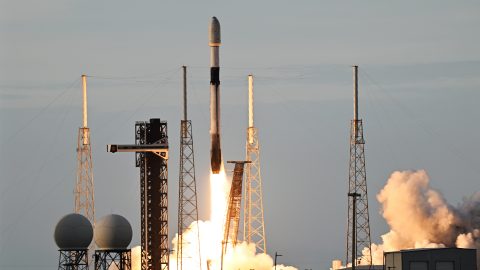
In its search for international satellite companies to provide backup internet services, National Science and Technology Council Minister Wu Cheng-wen (吳誠文) revealed last week that Taiwan is looking beyond last year’s multi-million-dollar partnership between state-owned Chunghwa Telecom and Eutelsat OneWeb because of a bandwidth issue. As an alternative, Taiwan is now in talks with Amazon to provide its satellite service “Project Kuiper.”
AI
Taiwan’s science ministry has warned funding for semiconductors, AI and aerospace initiatives could be reduced by $20 billion New Taiwan dollars (around $609 million) next year, after opposition parties voted to redirect spending to local municipalities.
Campaigners and academics say hype around AI is driving Taiwan’s chip factories toward unsustainable emissions. “The AI market is becoming more crazy than ever,” Lena Chang (張皪心), a campaigner at Greenpeace East Asia, told Al Jazeera. “Because of it, the energy use of the semiconductor industry is becoming a major problem for Taiwan, because of increased emissions and even possible shortages.”
Computing
American computing giant Super Micro Computer Inc. has announced plans to set up a renewable energy-powered computing center in Taiwan.
Green Transition
On December 6, Taiwan’s Ministry of Economic Affairs announced it will allocate $4.08 billion New Taiwan dollars ($125.9 million) for rooftop solar panels. The scheme aims for installations on at least 120,000 households.
The National Taiwan University ZERO team has developed “Membrane Carbon Capture” and “Electrochemical Carbon Conversion” technology in the form of a machine capable of converting CO2 into formic acid or syngas. It can convert 50 kilograms of CO2 per day. For every kilogram of CO2 captured, around 0.4 kilograms of emissions is generated.
Taiwan experienced its hottest year on record in 2024. Minister of Environment Peng Chi-ming (彭啟明) said in August that Taiwan’s emissions had only reduced by 1.8 percent between 2005 and 2022. Peng said reaching the goal of reducing emissions by 23 percent to 25 percent compared with 2005 by 2030 would “in reality be hard.”
Medical Tech
A team working at the Taiwan Brain Technology Innovation and Application Project has developed the world’s first ultra-high-speed 4D microscopes which, combined with AI technology, increase the clarity of brain images by up to ten times.
A research team led by National Tsing Hua University Professor Lin Yu-chun (林玉俊) has developed a system that could help stop coronavirus invading human cells, control insulin secretion, nutrient absorption, and nerve conduction. The “riveting” system uses light to stop cell transport.



Leave a Reply