
Taiwan Tech Update is a roundup of the latest tech developments in Taiwan. This roundup details issues with the development of “Taiwan’s Starlink” satellite project and Foxconn building a supercomputer with Nvidia AI chips.
Semiconductors
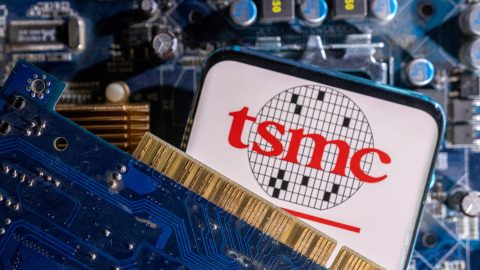
Taiwan President Lai Ching-te (賴清德) said that semiconductors were a “key reason” for the world to want to protect Taiwan in an interview at the start of September. “Since TSMC’s operating system is very complex, not any group of people could just take it and continue to operate it,” he said in a TV interview.
Taiwan Semiconductor Manufacturing Co.’s new semiconductor plant in Arizona achieved yield rates comparable to those in its Tainan plant in one trial, according to a Bloomberg report. Yield rates refer to the percentage of chips that are usable and thus dictate profitability. TSMC did not confirm the story but said the project was going well.
Space Industry
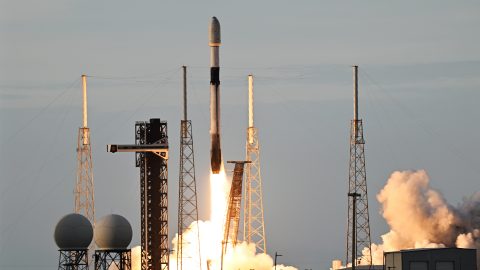
Taiwan’s low-Earth orbit satellite program has faced a setback, with a planned 2025 launch now pushed back to 2027. Problems with the communication payload on the satellites, which are ultimately intended to become the equivalent of a Starlink network, have seen it replaced by components made elsewhere. The program is managed by Taiwan Space Agency, but the Industrial Technology Research Institute is responsible for the communication payload.
Earlier this year, war games run by the Nonproliferation Policy Education Center suggested a potential vulnerability in relying on foreign companies for satellite coverage. Taiwan currently uses Eutelsat OneWeb’s satellite services as a stopgap before it can develop its own. However, during the Nonproliferation Policy Education Center exercise, the hypothetical Eutelsat OneWeb team “refused to offer additional communications support to Taiwan beyond existing contracts” after a satellite collided with a Chinese satellite, citing shareholder pressure.
At a forum held in September, Loren Chang (張起維), a professor at National Central University’s Department of Space Science and Engineering, said subsidies for local satellite research and development remain too low.
AI
Politicians and captains of industry have continued to talk up Taiwan’s positioning in relation to the future of AI. Speaking at the Taiwan AI Academy Annual Conference on September 27, Taiwan’s Vice President Hsiao Bi-khim (蕭美琴) said many labor shortage issues can be solved by AI. At the same conference, Pegatron Corp (和碩) chairman Tung Tzu-hsien (童子賢) said that Taiwan’s “excellence in hardware manufacturing” gave it an advantage in efforts to capitalize on the rise of AI.
At the start of this month, Foxconn Chairman Young Liu (劉揚偉) said demand for chips used for AI remains “crazy.” He was discussing the development of the world’s largest assembly plant for servers which carry Nvidia’s most advanced AI chips. “There was a lot of talk that the need for compute may be saturated pretty soon. But it looks like the demand is still growing. So that’s beyond our expectations,” he said.
Liu was speaking after Foxconn, known formally as Hon Hai, reported its highest-ever third quarter sales. It made 1.85 trillion New Taiwan dollars ($57.88 billion) last quarter, up 20.15 percent on last year.
On September 9, Wu Cheng-wen (吳誠文), minister of the National Science and Technology Council, visited Silicon Valley to promote the concept of Taiwan as an “AI Island.”
Computing
Foxconn is set to build Taiwan’s largest supercomputer using Nvidia’s AI chips. Supercomputers are computers that operate at the highest levels of performance, as compared to everyday computers. An Nvidia blog said, “With an expected performance of over 90 exaflops of AI performance, the machine would easily be considered the fastest in Taiwan.”
Acer released its first handheld gaming device this month — the Nitro Blaze 7. A press release said it uses an AMD Ryzen 7 8040HS APU and 16 GB of RAM.
Medical Tech
Taiwan’s Ministry of Health and Welfare has approved subsidies for 16 medical institutions to set up AI Centers that promote the use of AI in healthcare. Health and Welfare Minister Chiu Tai-yuan (邱泰源) said AI could ultimately help solve labor shortages and sustain the national health insurance system.
Speaking at an annual biotech meeting at the end of August, Taiwan Premier Cho Jung-tai (卓榮泰) cited Taiwan’s first-place ranking in Numbeo’s international Health Care Index while praising Taiwan’s healthcare and biotechnology industries. Emphasizing the government’s efforts to develop AI and data-driven smart medical care, he said next year’s government budget for technology development will reach NTD 146.6 billion ($4.6 billion), which is 14.9 percent higher than this year.
At the same meeting, Wu Cheng-wen (吳誠文), head of the National Science and Technology Council, said Taiwan’s technology and healthcare sectors should pursue greater integration. Quanta Computer Chairman Barry Lam (林百里) gave a speech about a new smart technology platform that can offer individualized healthcare solutions.
Green Transition
Taiwanese energy management company GreenHarvest (睿禾控股股份有限公司) won the Australia-Taiwan Partnership Award this month for contributions to sustainable energy. The company owns a large solar portfolio and also launched a renewable energy supply platform to help local businesses access renewable electricity.
Taiwan’s Ministry of Environment held an event with participants from Argentina, Brazil, Columbia, Malaysia, Taiwan, Thailand, Tuvalu, Vietnam, the Philippines and the U.S., sharing techniques for “circular production” of electronic appliances and devices. Circular production involves sharing, leasing, reusing, repairing, refurbishing and recycling existing materials and products for as long as possible.
Taiwanese company UKL (优织隆企业股份有限公司) said it has made a pineapple leaf fabric that is less carbon intensive than cotton and other materials.



Leave a Reply