
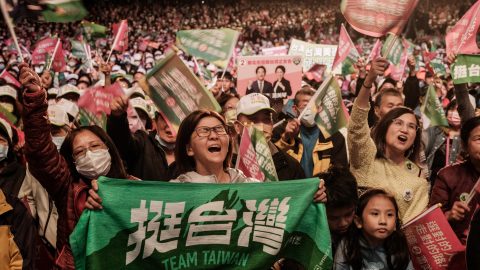
The Taiwanese democratic process is a sight to behold. Final rallies by the three electoral candidates brought hundreds of thousands to the streets on the eve of the January 13 election. Rallygoers disbanded peacefully at 10 p.m. that night.
The people voted from 8 a.m. to 4 p.m. the next day. Ballot opening was public across the island after 4 p.m. Results were clear by 7:30 p.m. Losers conceded at 8 p.m., and the winner rolled out an elegant victory speech at 8:30 p.m. And though some felt disappointment — inevitable in any fair and free election — Taiwanese across the political spectrum share pride in the self-ruled island’s well-functioning, speedy electoral process.
In the end, the incumbent party — the Democratic Progressive Party (DPP), led by Vice President Lai Ching-te (賴清德) — won the presidency with just 40.1 percent, compared to 57.1 percent for incumbent president Tsai Ing-wen (蔡英文) in 2020, but lost control of the Legislature — the DPP ended up with 51 seats out 113.
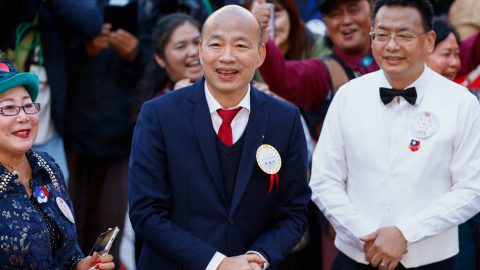
The main opposition party — the Chinese Nationalist Party (KMT), led by Ho Yu-ih (侯友宜) — failed to take power, with just 33.5 percent of votes. The party did gain a plurality of seats in parliament. Han Kuo-yu (韓國瑜), former presidential candidate in 2020 and top of the KMT’s list of 34 legislator-at-large nominations, was elected speaker of Legislative Yuan in a runoff vote on February 1.
The Taiwan People’s Party (TPP), led by the outspoken Ko Wen-je (柯文哲), won the youth and undecided votes, scored more than expected (26.5 percent) and grabbed a crucial minority in parliament with eight seats. They demonstrated their autonomy by refusing to cooperate with either the DPP or KMT in the Legislative Yuan speaker election.
The democratic process in Taiwan proves remarkably resilient despite Chinese pressures and geopolitical tensions around the island. Efforts at nudging or threatening voters through social media, economic risks or other means did not seem to have an impact on how voters cast their ballots. Results are extremely close to the figures reflected in opinion polls and can be explained through party identity and domestic variables.
This confirms the maturity of democratic institutions and voters. Last-minute events, such as the overflight of a Chinese satellite or former president Ma Ying-jeou’s (馬英九) controversial remarks on German television, did not sway results in any significant way. The elegant concession speech by the KMT candidate a mere four hours after the closing of voting stations was a textbook democracy-enhancing move.
Voters in Taiwan delivered a balanced election outcome, sending clear messages to each of the three parties. The DPP was rewarded for pragmatic governance with a clear presidential victory, but was also reminded that 60 percent of voters are not happy with the economic, social and energy situation — put simply, they expect more. The turnout (71.9 percent) was lower than in 2020 (74.9 percent) despite the great weather, indicating a lack of excitement by many voters.
The KMT fared respectably, especially in parliament, and it now controls two-thirds of local governments. But the party failed to gain the favor of younger voters. It also failed to convince voters who were disappointed by the DPP to vote strategically. The KMT must rejuvenate its cadres and message in the future.
The TPP made waves by winning 2-3 percent more than expected. It has earned a mandate from younger generations to push the government for pragmatic solutions to social and economic issues, with the caveat that many female and LGBTQI+ voters preferred the DPP over the TPP, owing to past remarks by former mayor of Taipei Ko Wen-je against both groups. The net outcome is a divided government between the presidency and parliament.
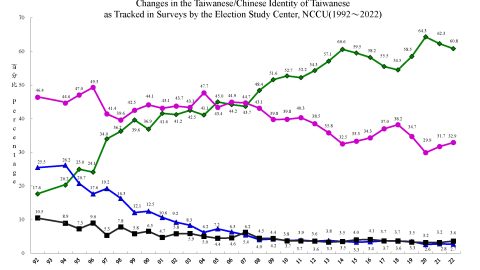
Despite the rhetoric about peace and war or democratic survival, domestic issues dominated issues regarding security and cross-strait relations in voters’ eyes. Voters calculated that cross-strait relations are tense, but are structurally constrained by the United States and China. The platforms of the three parties converged on questions of the appropriate size of the defense budget (3 percent of GDP) and protecting Taiwanese identity, despite concerns about the KMT’s past closeness with China or Lai’s pro-independence positions in the past.
Domestic policy will be challenging for the Lai government for three main reasons. Lai will need to compromise with either the TPP or KMT to pass anything through parliament. Lai also has a smaller popular mandate than Tsai. Finally, he will be forced to deal with a more complex economic and energy situation, as well as a tricky global political situation.
China’s response to the Lai government in the coming months is hard to predict. On the one hand, China has called Lai a “troublemaker” and a “separatist,” despite his pro-status quo campaign. Trust is low and communication channels are absent. China immediately punished Taiwan through a diplomatic victory. On January 15, Nauru announced that it switched diplomatic recognition from Taiwan to China, reducing the number of countries that formally recognize Taiwan to just 12. China could well escalate economic and military pressures.
On the other hand, Lai sounded reassuring notes in his victory speech — supporting status quo and peace — and could well make cautious pragmatic openings. Sophisticated Chinese players will know that voters delivered a pro-status quo verdict. It remains to be seen whether they or more nationalist actors shape the response. On the whole, China was not the dominant issue of the election.
Taiwanese voters have proved to be sophisticated users of electoral power, immune to external pressures, yet careful with distributing spoils. They voted both for the overall status quo and for reformist economic and social policies.
Yves Tiberghien is Professor of Political Science at the University of British Columbia, a Harvard Academy Scholar, and Visiting Professor at the Taipei School of Economics and Political Science.
Chung-min Tsai is Professor of Political Science at the National Chengchi University and at the Taipei School of Economics and Political Science, National Tsing Hua University.
This article is republished from East Asia Forum under a Creative Commons license. Read the original article.


Leave a Reply