
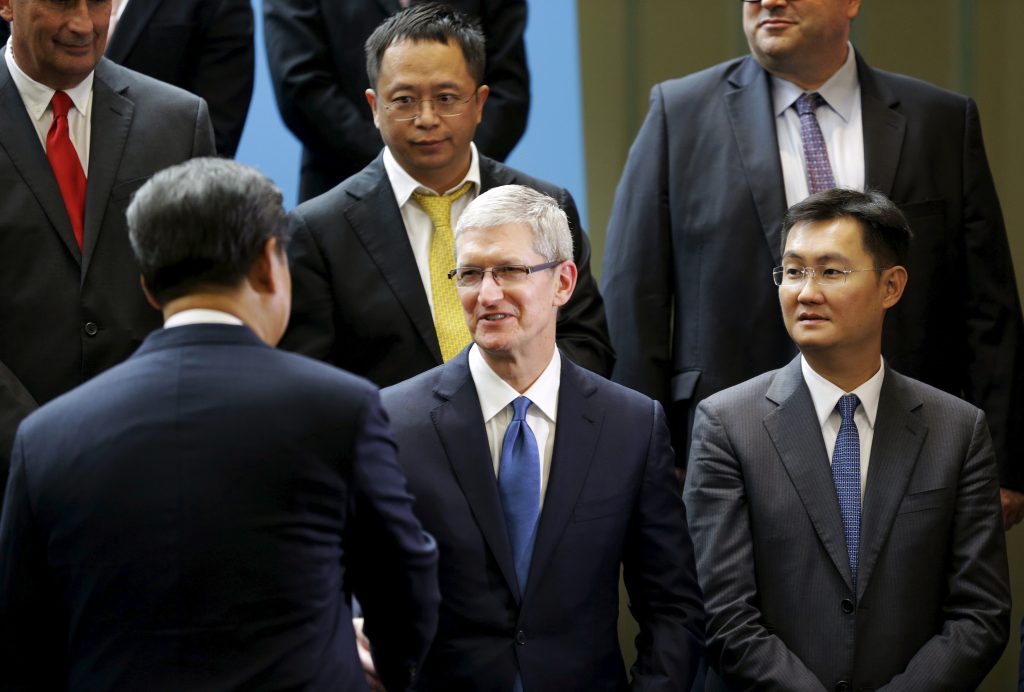
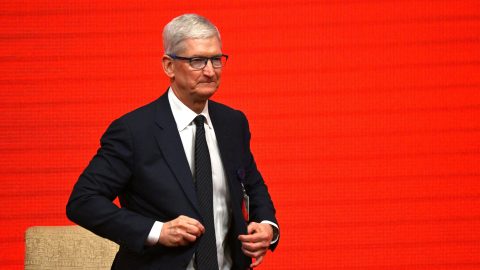
One of the world’s most important diplomats was in Beijing this week attending the China Development Forum: Apple CEO Tim Cook. That Cook’s name is plastered all over Chinese state media to laud the Chinese market might appear charged amid U.S. President Donald Trump’s renewed trade war with Beijing. But Cook’s appearance at the forum is an extension of a diplomatic strategy he employs in Washington as well.
Despite being at odds, Trump and Chinese President Xi Jinping (習近平) have similar goals when it comes to Apple — more domestic investment. As Apple’s chief diplomat to both countries, Cook caters to each by showing respect and supporting their core interests. Cook is a good diplomat, and while it seems that he’ll be able to walk this line for now, he might not be able to forever.
Apple began manufacturing in China in the 1990s to reduce production costs. Since then, Apple has deepened its engagement with China, rooting the manufacturing arm of its business in the country even when other American tech companies chose (or were forced) to leave. Despite making efforts to diversify its supply chain in recent years, Apple remains incredibly enmeshed in China. Over 95% of Apple’s products — including iPhones, Macs, AirPods and iPads — are made in China. And as of 2023, 84% of Apple’s suppliers primarily do their manufacturing in the country. Cook himself has said that “There’s no supply chain in the world that’s more critical to us than China.”
Moreover, 17% of Apple’s 2024 revenue came from the “greater China” region. But Apple is losing market share to Chinese smartphone competitors. Last year, Huawei overtook Apple in China’s market with 16% market share, compared to Apple’s 15%.
Apple needs to stay in the good graces of the Chinese consumer in the face of fierce domestic competition. Outside an Apple retail store in Shanghai last year, a Chinese woman yelled at people in line, “You worship and favor foreign things.” To which one person responded, “Do you know how many jobs Apple brings to China every year?” “No need, we have our own Huawei,” the instigator replied. The cultural tension surrounding the purchasing of local goods in China is probably why Tim Cook does public diplomacy in the country — for example, meeting with local college students. He has also been vocal about the fact that Apple manufactures in China not because the labor is cheap but because there is an abundance of highly skilled labor for innovation and process engineering.
Apple also needs to stay in the good graces of the Chinese government, particularly as it tries to roll out Apple Intelligence in China by May. Part of Apple’s efforts to keep the iPhone competitive in the Chinese market is the integration of AI features. But AI models used in China need to be approved by the Cybersecurity Administration of China, and to date, there is no public record of an American AI model being approved for deployment in China. Apple is layering Alibaba censorship software onto its own AI models to pass muster — one can imagine that there’s an immense amount of back and forth between Apple and the Chinese government right now, even during the final stages.
Showing support for China at the China Development Forum certainly doesn’t hurt Cook’s efforts. In recent months, Cook has made appearances at similar forums in China and reaffirmed his commitment to expanding investment in the country. These appearances are framed in Chinese state media through the recurring narrative that Apple’s business in China signals the successful opening up of the Chinese market to foreign companies. As China’s economy slowly recovers from the pandemic and the collapse of its real estate market, Beijing is eager for more foreign investment. Cook’s support is highlighted in state media because China wants to send the signal to foreign investors that its market is open to them. If an American tech giant can invest in China, surely anyone can.
Cook also has his work cut out for him in the U.S., where Apple is facing new tariffs that could significantly raise the cost of production of Apple’s various consumer electronics. Bank of America analysts estimated that Trump’s initial 10% tariff on Chinese goods would require Apple to raise prices by 9% to make up for the loss — Trump has since raised this tariff to 20% and promises more in the future. But Tim Cook probably isn’t shaking in his Nikes.
Cook successfully lobbied Trump during his first administration to grant Apple exemptions from tariffs. Trump began levying tariffs on Chinese exports in September 2018, which initially encompassed Apple products manufactured in China. In July 2019, Trump restated his commitment to the tariffs, writing on Twitter, “Apple will not be given Tariff waiver, or relief, for Mac Pro parts that are made in China. Make them in the USA, no Tariffs!” By September of that year, however, the U.S. Trade Representative had granted Apple exemptions on ten of its items and gave the company refunds for the tariffs already paid over the course of the previous year.
Trump stated that it was Cook’s lobbying that changed his mind — specifically Cook’s willingness to speak with Trump personally (which Trump said other tech leaders were not willing to do) and his argument that the tariffs would advantage Apple’s competitor Samsung. Reports indicate that Apple might also have threatened to shift some of its production out of the U.S. due to the cost of tariffs.
Trump 2.0 is redoubling its efforts to leverage tariffs in exchange for “America first” wins — i.e., bringing manufacturing back home. While this is impossible to do in the short term, Apple made an expensive gesture toward this goal last month when it promised to invest $500 billion in the U.S. and create 20,000 new jobs over the next four years.
This announcement in and of itself isn’t extraordinary. At the beginning of former U.S. president Joe Biden’s administration, Apple similarly announced a $430 billion investment and promised 20,000 new jobs over five years. But it will likely aid in Cook’s efforts to lobby for exemptions from tariffs because an investment of this scale is important to Trump’s politics — he leaked the plan and took credit for it, or at least gave his tariffs the credit. And while Apple’s official statement about the investment doesn’t mention Trump by name, it does use the words “manufacture” or “manufacturing” 53 times (the 2021 investment announcement used this word only 9 times), which seems like a nod to Trump’s agenda.
In contrast to tech leaders like Mark Zuckerberg of Meta, who has clumsily alternated between fawning over and criticizing both Xi and Trump, Cook seems to prefer a subtler approach and the long game. He has maintained a consistent strategy in China and with Trump. He knows what they want and accommodates it. In return, he gets to continue building Apple’s muti-trillion dollar empire.
Looking forward, the question is whether this strategy is sustainable. China wants foreign investment right now, but Apple’s flourishing in China doesn’t exactly align with Beijing’s grand strategy. In the U.S., it might become more difficult for Cook to justify Apple’s business in China with his tried and true “world peace through world trade” message, especially as Apple Intelligence creates new censorship demands in the country. It’s clearly not the case that trade will change China’s anti-democratic practices — so how long will this hold water with the American public?




Leave a Reply