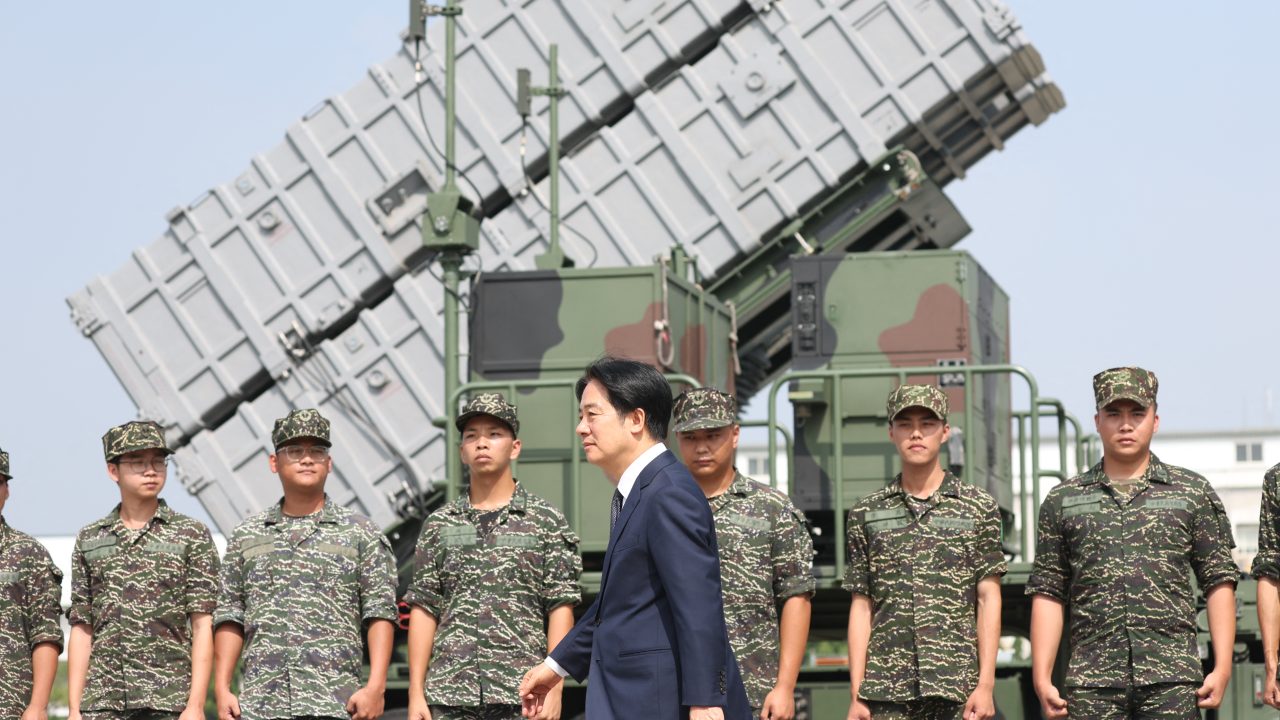
U.S. President Donald Trump has still not told the world what his Taiwan policy is yet. But people in Taipei don’t seem that worried.
Trump got off to a rocky start on Taiwan, even before his second term had started, telling Bloomberg in an interview, “They did take about 100% of our chip business. Taiwan should pay us for defense. You know, we’re no different than an insurance company. Taiwan doesn’t give us anything.” Needless to say, these remarks before the U.S. election led to consternation in Taipei.
Trump appointed people to his administration who were seen as pro-Taiwan. But he appointed others who caused concern in Taipei for things they had said, chief among them Elbridge Colby, Trump’s undersecretary of defense for policy. Some of those considered to be friendly to Taiwan have already been removed from their positions, such as National Security Council officials Alex Wong and David Feith. Others, like Secretary of State Marco Rubio, appear to have replaced their mojo with MAGA.
One thing that Trump has done with Taiwan specifically is sign significant agreements with TSMC, Taiwan’s semiconductor crown jewel. Some, like Max Lo (羅慶生), executive director of Taipei-based think tank Taiwan International Strategic Study Society, consider that TSMC’s value is being extracted, effectively under blackmail. But scholars like Ching-Fu Lin (林勤富) and Han-Wei Liu (劉漢威) have argued in favor of this “silicon statecraft.”
Of course, Trump has also imposed tariffs of 32% on Taiwan, only to reduce them to 10% a week later. Trump is also pursuing a huge trade war with China and picked many China hawks as his officials. However, because the U.S. caved on the tariffs so quickly, it’s still not clear what the long-term strategy is.
Former U.S. president Joe Biden appeared to break with Washington’s established strategic ambiguity, saying three times the U.S. would defend Taiwan. Trump instead has equivocated, saying that he “never comment[s] on that.”
Trump himself has a sort of Janus-like quality, where he has consistently acted in a way that appears hostile to China, while saying that he and Chinese President Xi Jinping (習近平) “love each other.”
There is cause for some optimism still. The U.S. State Department removed language about not supporting Taiwanese independence from its website in February. “America is committed to sustaining robust, ready and credible deterrence in the Indo-Pacific, including across the Taiwan Strait,” defense secretary Pete Hegseth said in Tokyo while on a visit in March.
Even though there is no clear Taiwan policy, a complacency has set in in Taipei. After four months, it appears like a new Trump normal is established, one that is more chaotic but fundamentally not a big departure from the last eight years. People still remember how Trump’s first term was good for Taiwan.
However, the Taiwanese public’s confidence in Trump’s America has declined since he came to power, after already dropping dramatically when Russia invaded Ukraine.
The ongoing experience of Ukraine could be seen as more instructive, given how the Trump administration is continuing to blame Kyiv for the failure of Russia to negotiate. This is after Ukrainian President Volodymyr Zelenskyy’s administration essentially accepted Trump’s underlying premise that they had to negotiate a peace that would see the loss of significant Ukrainian territory.
Many in Washington have long believed that Taiwanese President Lai Ching-te (賴清德) is unreliable. Ivan Kanapathy, senior director for Asia at the National Security Council, told the Financial Times in 2023 when Lai secured the presidential nomination that there were concerns about his inexperience in international and cross-strait affairs.
Carnegie fellow Stephen Wertheim recently coauthored a piece in Foreign Policy saying Trump should rein in Taiwan, and that Lai is escalating tensions along with Beijing. He cited Lai designating China as a ”foreign hostile force.” Wertheim has recently visited Taiwan. “There might be some overconfidence in Taipei right now about where things could go with the Trump administration,” he said on a recent podcast.
It’s hard to set a scene when it is genuinely unclear what will happen next. For a long time, the future has been painted as quite binary: “Trump will support and defend Taiwan,” versus “Trump will make a deal with Chinese President Xi Jinping and abandon Taiwan.”
There is a third, more ambiguous path: Trump could tell Taiwan that it has America’s continued support but not only does it need to keep building foundries in the U.S., Taiwan also needs to find a way to talk to China and reduce tensions.
For Lai and his Democratic Progressive Party (DPP), that could be difficult. Since Lai’s predecessor, Tsai Ing-wen (蔡英文) came to power in 2016, Beijing has refused to deal directly with Taipei.
The Chinese government says this is because Tsai and Lai do not acknowledge the “1992 Consensus,” a heavily contested idea that both sides of the strait agree there is only “one China” but disagree on whether it is the Republic of China or the People’s Republic of China.
Lai speaks often and openly about the Republic of China. But the idea that it contests with the People’s Republic of China for “one Chinaness” is something that he has firmly rejected. There is also no guarantee that Beijing has been honest about this. Would they really talk with Lai?
The Taiwanese government needs to consider all possibilities. With Trump, it pays to expect the unexpected.





Leave a Reply