
Three weeks into Trump’s second term, is Taiwan still number one?
The early days of the new administration have been characterized by a whirlwind of executive orders, shocking announcements and actions by unelected anti-bureacreats of questionable legality. In the midst of this, there has been relatively little “Taiwan policy” enacted. But as a new political climate emerges in America, we can already start to understand and predict where Taiwan will fit in or get left out.
Arguably the most dramatic shift since January 20 is the U.S.’s international positioning. For all that America has been willing to invade countries the world over since the establishment of the post World War II order, it has never hitherto threatened to take the same action against its democratic allies. This is now in question. Trump and other Republicans have repeatedly called for Canada to become the 51st state, which seems on some level to not be serious, but Canadians have not taken it well at all.
More concerningly, Trump seems entirely serious about Greenland. After speaking with the U.S. president, Danish Prime Minister Mette Frederiksen reportedly determined he genuinely wants to acquire it as U.S. territory. It’s far from clear what action the U.S. would take to achieve this in the face of opposition from Greenlanders, the Danish government and Denmark, and the U.S.’s NATO allies in Europe, but the damage is already being done intellectually. America gets Greenland, Russia gets Ukraine and China gets Taiwan.
This reversion to the idea of great powers having hard spheres of influence is a clear threat to Taiwan and other U.S. allies in East and Southeast Asia. A world in which Greenland becomes American seems almost axiomatically a worse and more dangerous world for Taiwan to exist in.
From a different line, the climate in Washington to reduce American spending abroad also engenders risk for Taiwan. Domino Theory will cover the drive to cut aid and other spending in future articles, but here it suffices to say that to find a world in which the U.S. becomes more isolationist and Taiwan becomes safer, one has to pass through the eye of quite a narrow needle.
The actions of the Department of Government Efficiency, or DOGE, and the political rise of Elon Musk more generally also raise questions for Taiwan. Project 2025 called for massive investment and defense reform, but Musk is apparently going to look at the Pentagon’s budget. While I have previously written cautiously that Musk’s ties to China are overplayed, there is no doubt that they exist.
On the other side of the coin, so far the Trump administration appears to be heading for full-on competition with China. Washington has already announced a slew of tariffs on Chinese goods, and Beijing has responded with targeted tariffs and other countermeasures in response. While neither side seems in a rush to escalate to a comprehensive trade war, that is certainly one of the likely outcomes at this stage.
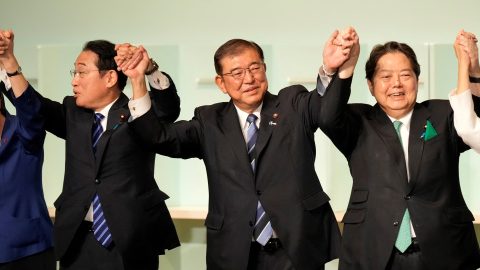
There have been a lot of small signals that militarily it is so far business as usual for the U.S. in the Western Pacific. This week the USS Ralph Johnson conducted the first American transit of the Taiwan Strait in 2025. Last week American bombers and Philippine fighter jets conducted a joint drill above the South China Sea, for the first time. And when Japanese Prime Minister Ishiba Shigeru met with Trump for the first time on February 7, their joint statement reiterated the importance of “maintaining peace and stability across the Taiwan Strait.”
Despite Trump yesterday repeating his previous claim that he has a good personal relationship with Chinese President Xi Jinping (習近平), his first term was characterized by a paradigm shift on China that has since become a bipartisan consensus. So far, and of course it is early, things don’t look so different within the relationship. While Taiwanese leaders might dissemble and claim that they support a positive relationship between Washington and Beijing, it is generally the case that for Taiwan a more fierce American-Chinese competition is beneficial.
The strange intersection of a China-skeptic administration and a return to the Monroe Doctrine is Panama. In the run-up to his inauguration, Trump repeatedly claimed, without evidence, that there were Chinese troops stationed at the canal and that America should “take back” possession of it. After Secretary of State Marco Rubio visited Panama City, Panamanian President Jose Raul Mulino announced that Panama would not be renewing its involvement in China’s Belt and Road Initiative. There are also now legal cases aiming to challenge the right of a Hong Kong company to operate ports at either end of the canal.
While what appear to be American strong-arm tactics that impinge on Panamanian sovereignty will feed into fears that Taiwan itself could be similarly treated, there will be many in Taipei who are secretly happy to see the U.S. acting so aggressively to “push back” China.
For Taiwan itself, Trump has continued his threats to put huge tariffs on Taiwanese semiconductors in a bid to bring production back to the U.S. Since it would take more than a single presidential term to set up new American chip foundries, in the short term such tariffs would drive up costs for American tech companies. There are no alternatives to replace TSMC’s chips at scale.
The goal for Taiwan would therefore be to try to weather the storm of the announcement of tariffs without alienating Trump, until domestic pressure persuades him not to implement them. It would help if Taipei has deals and deliverables lined up and waiting to go for this moment. The one thing that Taiwan must at all costs avoid is a Trump statement of total clarity that he would not act to defend Taiwan.
Domino Theory wrote at length about the people around Trump who are favorably inclined towards Taiwan. These relationships have obviously not diminished in importance, and Taipei is no doubt continuing to work out how to position itself so as not to attract any ideological ire or stray bullets from DOGE or Trump himself. But Taiwan also needs to play at the other end of the field. A lot of European partners are currently reevaluating their geopolitical positioning because of Trump, and most of them will be looking again at what Beijing has to offer. What Taipei can do to prevent this is not clear, but there will be many sympathetic ears and voices still to be found in parliaments and assemblies around the world.
One surprising development is that despite all his continuing rhetoric, Trump has not abandoned Ukraine. The U.S., for the time being, looks set to continue its support, with conditions of course. This will both reassure Taiwanese who fear their own abandonment and also make life easier for a Lai Ching-te (賴清德) administration that had staked significant political capital on democratic solidarity with Kyiv.
It’s only been three weeks, but the ground is shifting. It’s a time when the nimble-footed will thrive.
Update: Shortly after this article was published, it was announced that President Trump had spoken with Russian President Vladimir Putin in a phone call, and that negotiations between the U.S. and Russia to end the war between Russia and Ukraine would start immediately.



Leave a Reply