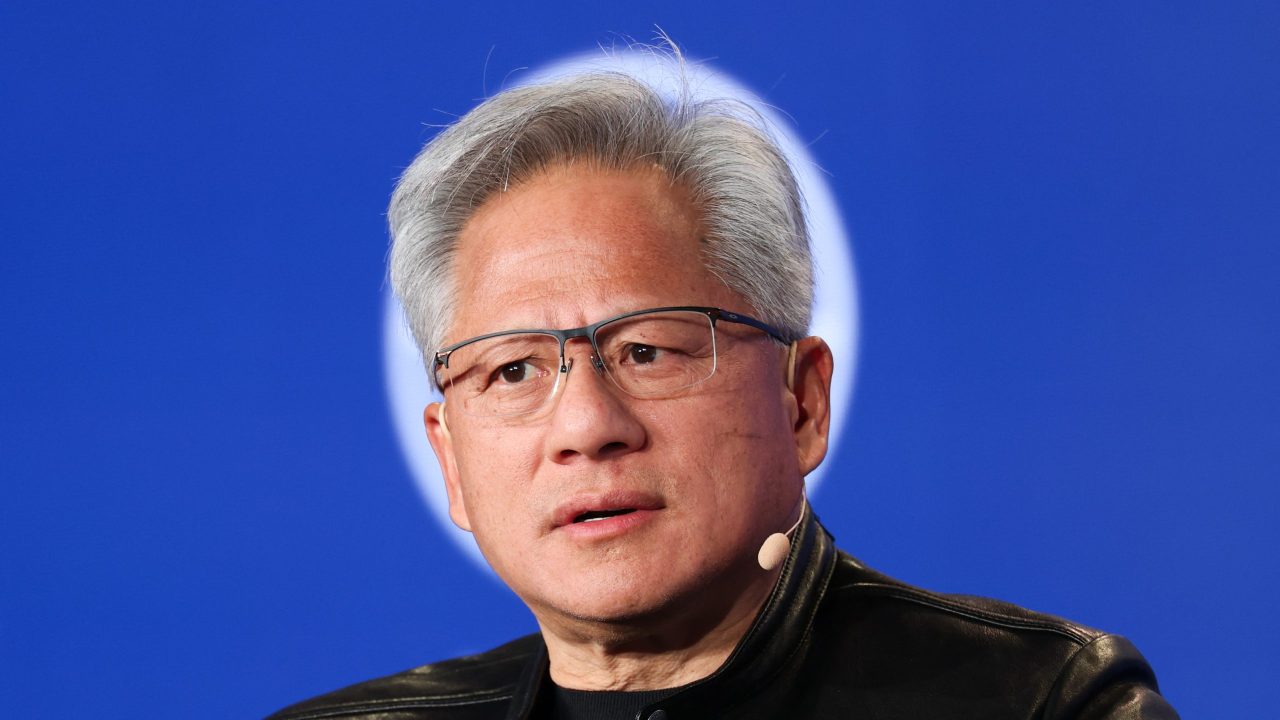
On Monday, the White House distributed a list of business leaders joining Trump on his trip to China. Nvidia’s chief executive, Jensen Huang, was missing from that list, despite being the head of the world’s most valuable company.
Huang’s absence was widely reported. In an article published on Monday, Reuters cited a source explaining that the White House planned to focus more on agriculture and commercial aviation during the trip.
But late Tuesday night, Huang was photographed boarding Air Force One in Alaska during a refueling stop en route to Beijing. CNBC cited a source saying that Trump invited Huang after reading the news coverage about his conspicuous absence. The New York Times reported similarly, noting that Trump gave Huang a call on Tuesday morning to extend the invite.
It’s possible “that Huang wasn’t invited until Trump found out that he wasn’t,” Derek Scissors, Asia economist at the American Enterprise Institute, told Domino Theory in an email.
In a post on Truth Social, Trump called the CNBC report about Huang’s exclusion from the trip “fake news,” although he didn’t specify when exactly the invite went out.
Scissors initially found it “odd” that Huang wouldn’t be joining Trump in Beijing before learning otherwise, while another China analyst and former Trump administration advisor said he was “not surprised.” “Huang is a Silicon Valley globalist who is not necessarily in sync with the anti-globalist Trump Admin,” the analyst wrote in an email Tuesday morning.
Speaking before the news of Huang boarding Air Force One broke, Hudson Institute senior fellow Jason Hsu (許毓仁) said the decision to not invite the chief executive reflected the political sensitivity around Nvidia and advanced AI chips. The Trump administration might be seeking to avoid the optics of putting “the most strategically sensitive AI chip company” at the center of the trip, Hsu wrote in an email. “The administration may want flexibility in the Trump-Xi meeting without appearing to let Nvidia or any single company drive U.S.-China policy.”
“Huang’s last-minute inclusion to the trip shows there could be a deal between U.S. and China on AI chips sales and export controls,” Hsu wrote in an updated statement. “The shift shows that Trump wants the CEO on the table to be bargaining chip.”
In the same post where he clarified Huang’s presence on Air Force One, Trump wrote: “I will be asking President Xi, a Leader of extraordinary distinction, to ‘open up’ China so that these brilliant people can work their magic, and help bring the People’s Republic to an even higher level! In fact, I promise, that when we are together, which will be in a matter of hours, I will make that my very first request.”
Trump in December agreed to allow limited shipments of the H200 chip, one of Nvidia’s most powerful AI processors, to China in exchange for a 25% fee for the U.S. government. The H200 had previously been subject to U.S. export controls targeting advanced AI processors.
Trump’s decision to relax the controls was a big win for Huang. But in March, the Financial Times reported that Nvidia shifted production away from H200 chips towards more advanced chip architecture, suggesting that the company doesn’t expect significant H200 sales in China. At the end of April, Commerce Secretary Howard Lutnick confirmed that Nvidia has not sold H200 chips to China, blaming difficulties in getting permission from the Chinese government.
Xi will likely urge Trump to relax U.S. chip export controls when the two meet. “Though China’s national security system is wary of importing U.S.-designed chips, the reality is that Chinese AI labs have no choice but to buy or rent them to serve their applications to global publics,” wrote Ryan Fedasiuk, a fellow at the American Enterprise Institute and adjunct professor at Georgetown University, in a message to Domino Theory.
“It is in Beijing’s interest to negotiate for greater chip access. Xi will almost certainly want to see the United States commit to ‘no new export controls’ — either framed as a good-will gesture in the name of bilateral stability, or as a precondition for dialogue about AI safety,” Fedasiuk said.
In a recent post on Substack, Fedasiuk wrote that “some in the U.S. AI industry” will amplify China’s case “behind closed doors.”
While the U.S. is not inclined to sell advanced chips to China, “President Trump likes to announce deals,” Scissors said. “If he wants large-scale Chinese purchases and Chinese pressure on Iran to offer better peace terms, the U.S. also must make concessions.”
The question now, with Huang by Trump’s side, is how chip export controls might be drawn into that trade-off.
This article has been updated to include new comments from Jason Hsu on Huang’s last-minute inclusion on the China trip.



Leave a Reply