China said that it carried out a “track 1.5 dialogue” with the U.S. in Beijing on August 25.
That’s not what really happened.
The event in question is a meeting that took place on August 25 between the International Department of the Chinese Communist Party and the Asia Society, a U.S. non-governmental organization that “provides a platform for dialogue.”
A meeting between an arm of the party-state and private American citizens might appear to be track 1.5 diplomacy at first glance, given that track 1 is official diplomacy and track 2 is dialogue between non-state actors. But is there any meaningful way in which the Asia Society was also able to speak on behalf of the U.S.?
The evidence does not support it.
The day before the dialogue, the Asia Society delegation met with China’s chief ideologue, Wang Huning (王滬寧), whose title is chairman of the National Committee of the Chinese People’s Political Consultative Conference, but whose power comes from his standing within the Chinese Communist Party. His position in the Politburo Standing Committee rankings suggests he is the fourth most powerful politician in China.
The U.S. side was led by John Thornton, a businessman who is director of the Global Leadership Program at Tsinghua University in Beijing, but who was appearing at the dialogue in his capacity as co-chair of the Asia Society Board of Trustees.
The immediate power imbalance between the two is evident.
So is the difference in which the event was reported. The dialogue was given good coverage in Chinese state media for multiple days. But participants on the American side, excluding Thornton, were not named in reports on August 25 itself. Names were only given in subsequent reports the following day.
Western media barely covered the event.
The Asia Society hardly acknowledged it, either, with nothing on its website, nor its X account. There is one brief mention on an Asia Society Policy Institute account.
Awareness of this event was totally delivered and shaped by the Chinese state, who characterized it as a meeting of state representatives.
But how qualified were the Asia Society participants to represent the U.S.?
Thornton has been criticized in the past for being too close to China. He is the chair of RedBird Capital Partners, which tried to buy the Daily Telegraph, a British newspaper. China hawk Iain Duncan Smith wrote an article on ConservativeHome at the time saying that Thornton’s connections to the Chinese state were neither “incidental or historical,” but rather “ongoing and it appears ideological,” adding that Thornton sat on the advisory council of China’s sovereign wealth fund and has chaired institutions aligned with the Belt and Road Initiative.
Using AI analysis and the Mark 1 human eyeball, Domino Theory analyzed video footage of the meeting with Wang and identified the main members of the Asia Society-led side. The finding was in complete agreement with a list separately published on social media site X by Jackie Deal, president of defense research firm LTSG.
Many of them have previously been involved with China engagement, including Jing Qian (錢鏡), the vice president of the Asia Society and co-founder of its Center for China Analysis. Qian also attended, with Thornton, the previous “track 1.5 dialogue” in 2024, also in Beijing.
The Chinese side was led by Liu Haixing (劉海星), head of the International Department of the Chinese Communist Party Central Committee. Liu is theoretically responsible for diplomacy between the Chinese Communist Party and foreign political parties, but in practice operates as a second foreign minister, meeting with foreign government officials in their official activities, as well as with party leaders.
The 2024 dialogue was attended by Liu’s predecessor Liu Jianchao (劉建超), who was reportedly detained in 2025. Plenty of change near the top for Thornton to grapple with.
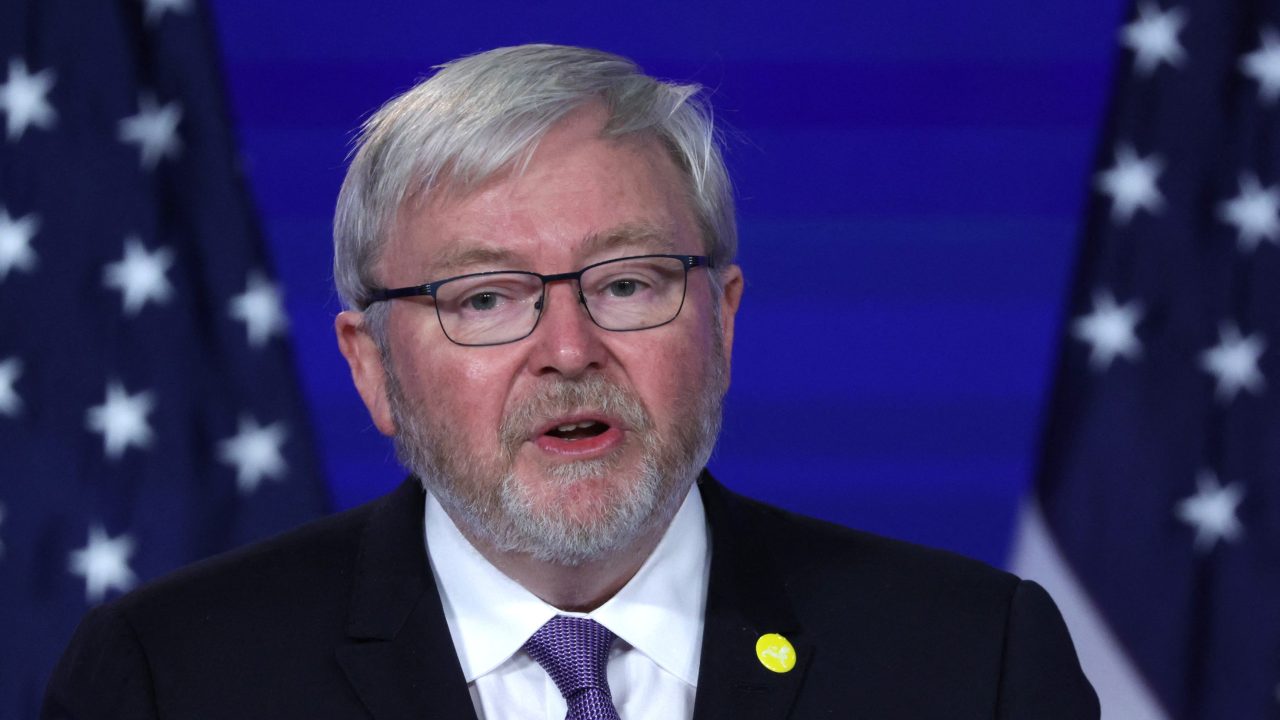
One new member on the American side was Kevin Rudd.
Rudd is many things. He is an experienced politician and diplomat. He is the new president and CEO of the Asia Society. He is a fluent Mandarin speaker and an old China hand.
He is also Australian, not American.
Rudd was most recently the Australian ambassador to the U.S. from 2023 until March 2026. More notably, he was prime minister of Australia from 2007 to 2010, foreign minister from 2010 to 2012, and then briefly prime minister again in 2013.
When speaking on Ezra Klein’s podcast in July, Rudd was asked about American policy toward Taiwan. He outlined three reasons why the U.S. should continue to deter China from invading, and then said this:
“I think those are active considerations for the American body politic. But as a barbarian living in your midst, far be it for me to tell you what’s right or wrong.”
When asked about their participation in the dialogue, the Asia Society directed Domino Theory to personal posts on Rudd’s social media, saying “here is what we are sharing.”
Rudd wrote that the dialogue was “important in the lead up to the Trump – Xi summit in Washington on 24 September.” But he didn’t say in what capacity, if any, he was representing or speaking for the Trump administration at the meeting. Neither did the Asia Society when asked about it via email.
Chinese state broadcaster CGTN said the dialogue was “more than another diplomatic meeting.”
In many ways, it was less than one as well.


Leave a Reply