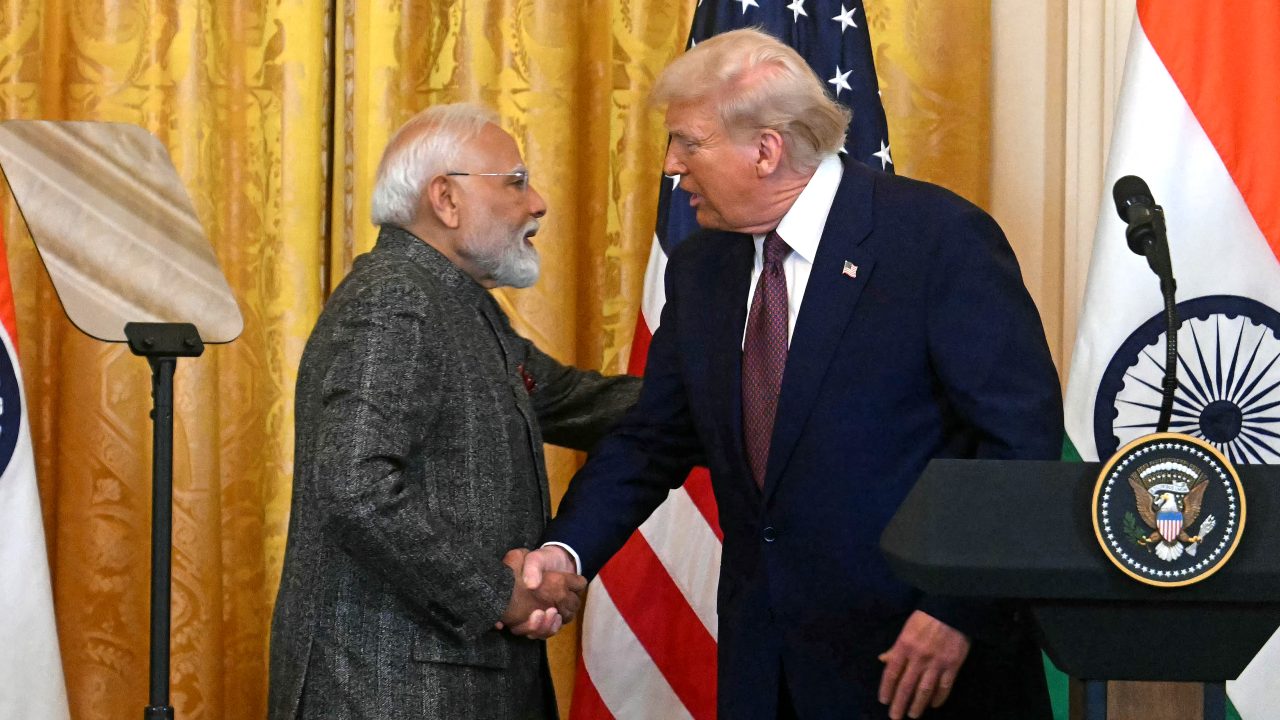
At the start of his second term, one of the first guests U.S. President Donald Trump invited to the White House was Indian Prime Minister Narendra Modi.
The visit ended in a new initiative for technology and military cooperation and a statement which “reaffirmed the strength of the India-U.S. Comprehensive Global Strategic Partnership, anchored in mutual trust, shared interests, goodwill and robust engagement of their citizens.”
But while all of that spoke of India’s strategic importance to the U.S. in its Indo-Pacific rivalry with China, it also spoke of the trickiness of keeping the world’s fastest growing major economy onside.
The U.S. wants India to stand up to China in the Indian Ocean, where six key shipping chokepoints control trade between Europe, Asia, Africa and the Middle East. The two sides have cooperation on emerging technologies as well as naval logistics. But in any rivalry with China, India is a piece that refuses to slot into a fixed position.
Mixed Messages
On the one hand, over the past ten years, border skirmishes have helped sour relations between India and China. After 2020’s Galwan Clashes, in which at least 24 soldiers died, visa restrictions were put in place and direct passenger flights between the two were suspended. At the same time, it’s openly acknowledged that countries in South Asia are playing the two off against each other. And the Quadrilateral Security Dialogue, of which India is a part with the U.S., has placed an increasing emphasis on maritime security and monitoring Chinese influence in the Indo-Pacific region.
On the other hand, when India speaks about pursuing a “multipolar Asia,” it comes within a broader framework of a “multipolar world.” That in some cases means working with China. In 2009, India joined BRICS, a grouping of developing countries that includes China. China remains its top trading partner. And after a warming of relations beginning with a deal in October, China’s foreign ministry confirmed at the end of January that direct passenger flights between the two would resume at an “early date.”
Multipolar World
These seemingly conflicting moves are a feature of India’s foreign policy approach, not a bug.
“Our endeavor at least for the last decade has been to try to see if we can actually develop all the big relationships — the non-big relationships as well — in parallel,” Subrahmanyam Jaishankar, India’s Minister of External Affairs said at a Chatham House event last week.
The aim is overt: “If we can do that successfully with all the major powers and groupings, that actually puts you in a much better position in a world which we could see was heading towards multipolarity,” Jaishankar added.
Response to Trump
Within this paradigm, there are some who emphasize India’s growing closeness to the Trump Administration. But others emphasize that closer relations between India and China could be temporarily convenient within the context of the Trump Administration applying tariffs to both.
“Economic headwinds are being faced by both India and China and both have an interest in ensuring the economic relationship continues to be managed in a (mutually beneficial) way,” Harsh Pant, foreign policy head at the Observer Research Foundation think tank, told Reuters at the end of January.
“If the threat from Mr. Trump increases for China’s economy, then China would want a relationship with India that is economically robust and strategically relatively sound compared to 2020.”
This view is already reflected, to some extent, in the facts. Alongside the possible resumption of direct passenger flights, on the table at the moment are discussions over provision of hydrological data and other cooperation over trans-border rivers. This forms a part of wider attempts to take “certain people-centric steps to stabilize and rebuild ties.”
There is also an agreement to resume the Kailash Manasarovar Yatra pilgrimage, which passes from India into Tibet. Subrahmanyam Jaishankar characterized that as one step toward pushing the relationship into a more “predictable and stable and positive direction.”
But there remain potential bumps in the road.
Bumps in the Road
To name just a handful of ongoing issues: The two sides are currently engaged in a competition for influence in Mauritius. India has said the China-Pakistan Economic Corridor goes against its “territorial integrity and sovereignty.” And China’s approval of a huge new dam in Tibet could be seen as an attempt to mark out territory, as John Jones, head of campaigns, policy and research at Free Tibet and Tibet Watch suggested at an online event hosted by the Institute for Security and Development Policy in January.
There may also be hard limits here. “The thaw between the two sides is much welcome, even though I do not think that in the long term, structurally speaking, the two sides can be peaceful neighbours and collaborating and cooperating with each other,” Happymon Jacob, who teaches foreign policy at New Delhi’s Jawaharlal Nehru University, told Reuters.
Judging Relations
So, what are the metrics through which interested observers — such as the U.S. — might judge relations warm or cold?
“The only credible metric would be a serious dialogue on the border issue and India relaxing constraints on Chinese investments in some critical sectors! Otherwise everything is tactical,” Harsh Pant told Domino Theory by email.
That is a view seemingly shared by Subrahmanyam Jaishankar:
“[W]hen two countries of this size, this history, this complexity, this consequence, rise broadly in parallel, and obviously they have an interplay with each other, I think the issue is: How do you create stable equilibriums?”
“The assumption for the last 40 years has been that there must be peace and tranquility in the border areas if the relationship is to grow. If the border is unstable or is not peaceful or is not tranquil, obviously it will have consequences on the growth and direction of the relationship.”





Leave a Reply