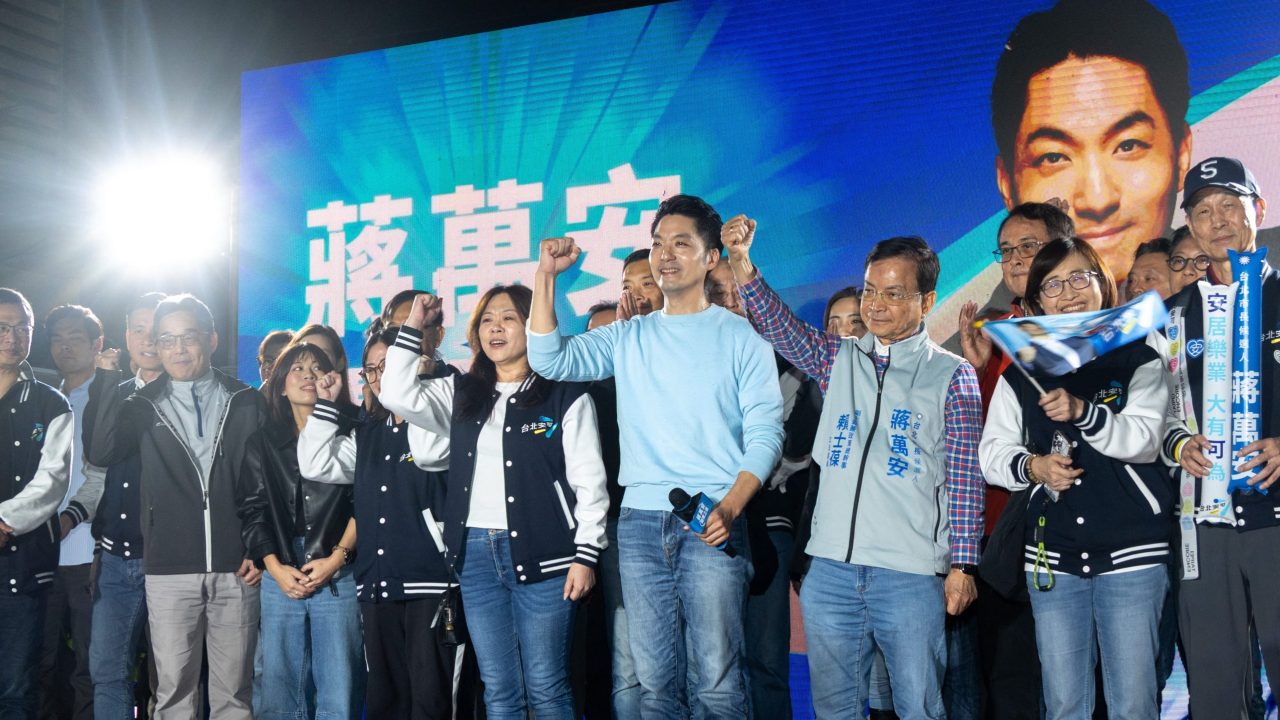
Incumbent Taipei Mayor Chiang Wan-an (蔣萬安) won a closely fought race against upstart challenger Puma Shen (沈伯洋), but his party lost several other key races in local elections held throughout Taiwan, according to media tallies.
Voting for mayors of Taiwan’s six special municipalities was dominated by local issues including transportation, quality of life and the environment. The results will not directly shape China policy, but the outcome will be read as an early test of electoral momentum before the 2028 presidential and legislative elections.
Taipei was the race Beijing watched most closely, given Shen’s (沈伯洋) record as a China critic. The Taiwanese capital has long been dominated by the Chinese Nationalist Party, or KMT, which favors closer ties with Beijing. Shen’s ruling Democratic Progressive Party, or DPP, emphasizes a more Taiwan-centric identity.
Chiang led by more than 100,000 votes as of 10:12 p.m., according to the Central Election Committee, in a contest that tightened sharply in the final weeks. The KMT also held on in New Taipei, Taiwan’s most populous city.
The DPP won in Taichung, a KMT stronghold, and eight additional counties and cities, including Tainan and Kaohsiung.
The results were “the best loss the DPP could hope for,” said Lev Nachman, a political science professor at National Taiwan University.
The office of mayor, especially in Taipei, is often a stepping stone to the presidency.
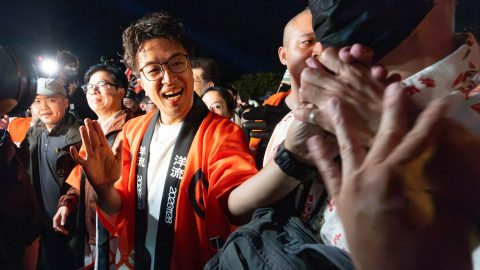
Chiang took the stage in front of a passionate crowd of Taipei voters to thank them for sticking with him. “The choice you made is a strong reminder for us. My team and I will do better to earn your recognition. Thank you!”
“Vote Chiang Wan-an! Everything is well and safe,” one passionate supporter shouted.
Shen conceded shortly before 8 p.m. and expressed appreciation to supporters who flocked outside the DPP’s headquarters in Taipei. “I can lose an election, but Taiwan’s democracy cannot lose,” Shen said in his concession speech to supporters, after telling them the count was “clean” and urging them not to share claims of vote fraud.
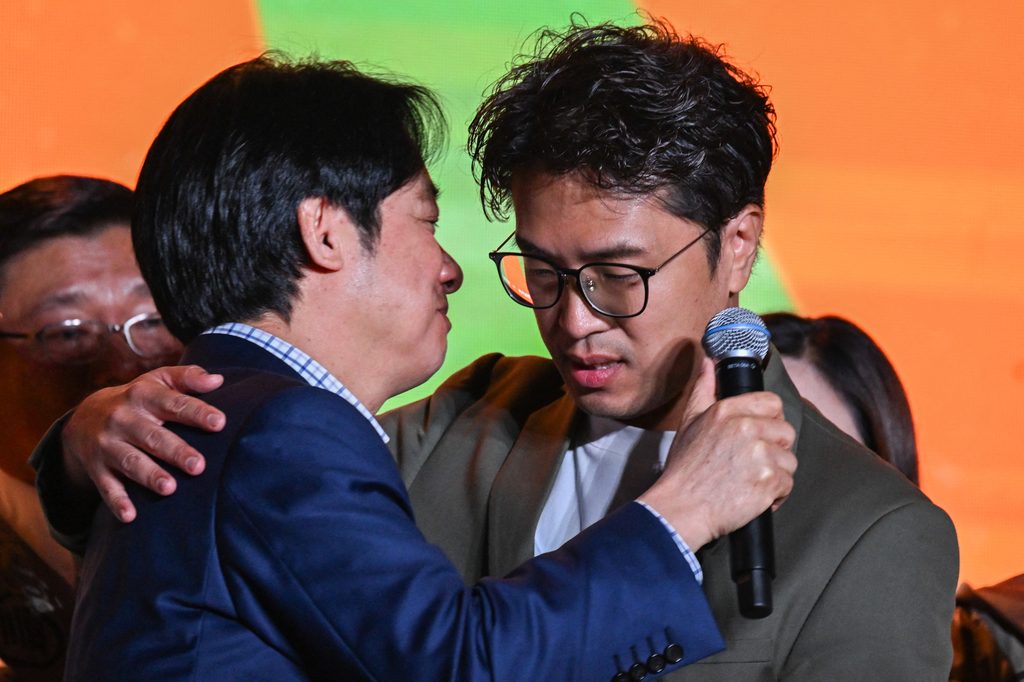
Shen entered the Taipei mayoral race as an underdog, but his campaign built a following that supporters call the “Ocean Current,” (洋流) a play on the character for “ocean” (洋) in his Chinese name.
The movement drew tens of thousands of people to rallies, and Shen piled pressure on Chiang prior to polling day. Shen, who rose to prominence as head of an NGO focused on disinformation and Chinese influence operations, steered clear of cross-strait issues during his campaign, focusing instead on local concerns such as schools, child safety and traffic.
Wang Li-hsiang (王禮翔), a 52-year-old commercial real estate agent, said he reluctantly voted for Shen as a check on the KMT. He said the KMT needs to be cautious in its relationship with China, and he was disappointed that the party did not seem to see this. “A good party needs to be balanced out by its competition,” Wang said.
The results of this election will create momentum for the upcoming 2028 presidential election. Sanho Chung (鍾燊豪), an assistant professor of political science at National Cheng Kung University, said the DPP’s success in today’s mayoral elections will give the party extra momentum for its 2028 campaign.
The KMT’s leadership, by contrast, faces more uncertainty as party members look for someone to blame. Losing Taichung “takes a lot of momentum away from Lu Shiow-yen (盧秀燕) and her entire presidential ambitions,” Nachman said. He expects the party’s 2028 candidate contest to turn on how its primary plays out. In his view, Cheng is unlikely to step aside soon, while former Chairman Eric Chu (朱立倫) will try to return to a leading role in the party.
Chung said Taichung Mayor Lu Shiow-yen (盧秀燕) could use the results to help choose a new KMT leader — perhaps herself — strengthening a possible 2028 presidential bid. But with the KMT’s hold on Taichung now at serious risk, “Lu could end up sharing the blame for missing the handoff in her home turf.”
China’s Taiwan Affairs Office said the election results reflected that mainstream public opinion in Taiwan favored peace, development and cooperation across the Taiwan Strait.
“No matter how the internal political situation in the island changes, it cannot change the direction and trend of the forward development of exchanges across the Taiwan Strait,” the office said in a statement, adding that Beijing would continue to “firmly crack down on Taiwan independence separatist forces,” “oppose external interference,” and “advance the great cause of national reunification.”
The Mainland Affairs Council, Taiwan’s governing body that oversees relations with China, urged Beijing to accept the results and to engage Taiwan’s elected government in dialogue and cooperation.
The council said the elections showed the resilience of Taiwan’s democracy, and that Beijing “should respect Taiwan’s democratic system and the choice of the Taiwanese people.”
This story was updated at 7:12 p.m. on November 29 with comments from Taiwan’s Mainland Affairs Office and China’s Taiwan Affairs Office.



Leave a Reply