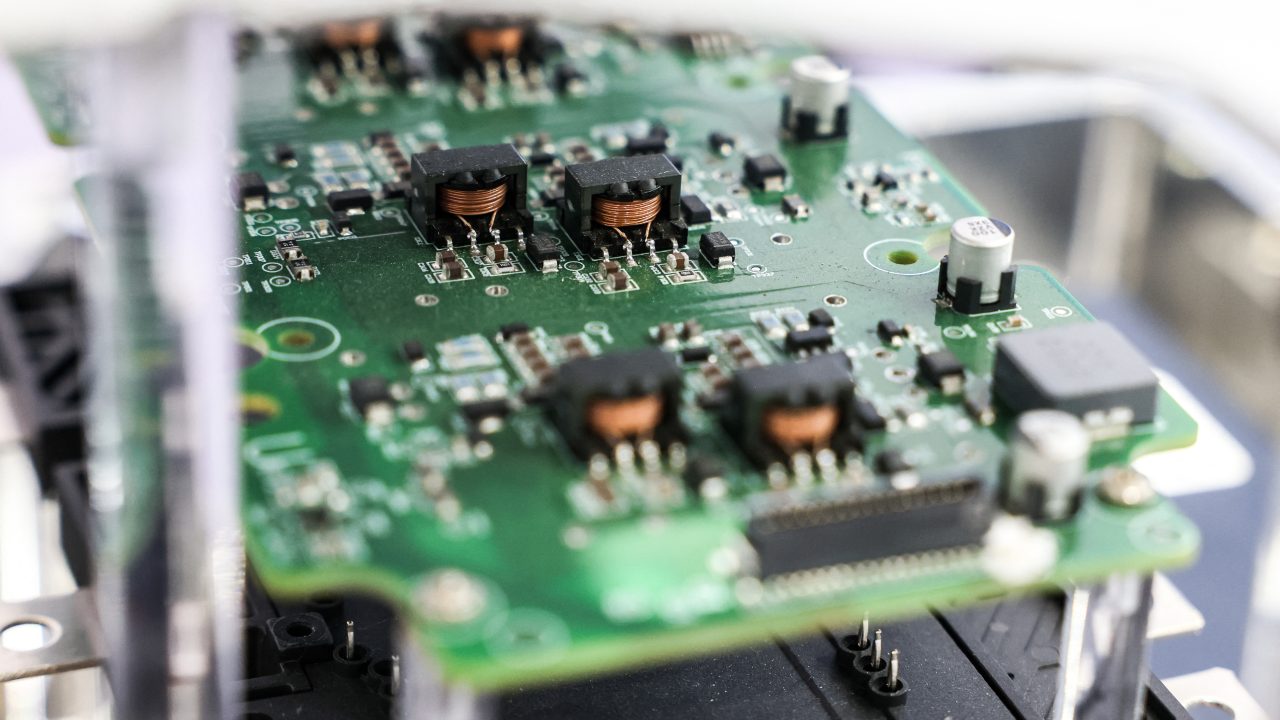
As much as skyrocketing AI demand has been a boon for Taiwanese tech, it has also put stress on the system.
“The whole world is here to have a piece of Taiwan,” a cab driver said while pulling up to Semicon Taiwan, one of the world’s leading trade shows on semiconductors, on Wednesday morning. Throngs of people were already gathered to see 1,300 or so companies on display. More than 40 of these companies focus on the final stage of the chip manufacturing process: chip packaging.
After chips are manufactured, they are then assembled and sealed, a process that can involve hundreds of discrete steps. As chips become more advanced, they require bigger and more complex packages. Multiple chips and memory dies, connected by dense, microscopic wiring, need to be able to withstand thermal and mechanical stresses so the package does not bend and warp.
At Semicon’s 3DIC Forum, leaders in Taiwan’s chip packaging industry across thermal management, equipment and system integration discussed the difficulty of adjusting the ecosystem to quick-moving product cycles. They said more integration between their companies is necessary for the ecosystem to operate as a cohesive whole.
In the past, industry players worked more independently, developing technology that could beat out others, said Eric Lin (林偉), general manager of Jentech Precision Industrial. “But now the speed of change and the speed of design updates is so fast,” said Lin. “Vertical integration must be done. We must jointly develop at an early stage, exchange each other’s roadmaps, and establish product verification platforms.”
One mistake in the packaging process can cause irreversible damage and cost somewhere between hundreds and thousands of dollars per unit. “If it’s broken, it’s broken,” said Michael Hung (洪松井), ASE Kaohsiung’s executive vice president overseeing the firm’s engineering and system-in-package divisions. “[T]he cost is very, very high.”
TSMC, Taiwan’s semiconductor giant, currently provides 90% of the industry’s advanced packaging. Its proprietary advanced packaging process is called CoWoS, which stands for chip-on-wafer-on-substrate. The process has been in development for over a decade, but it wasn’t until 2023, when ChatGPT came out, that the demand for AI chips, and thus CoWoS, skyrocketed.
TSMC’s capacity to do advanced packaging is now stretched extremely thin. The supply-demand gap for CoWoS is about 20% as of June 2026, according to reporting. And the company has no more capacity to dole out until new facilities come online, said Bruce Bateman, chip expert and head of Bateman Research. After two more fabs are completed in 2028 — one in Taiwan and one in Arizona — it will be at least another year before they can produce good yields.
At the Touch Taiwan electronics expo that took place in Taipei in April, an executive at C Sun, a Taiwanese advanced packaging equipment supplier, told Domino Theory that Nvidia has secured over half of TSMC’s CoWoS capacity, leading other chip designers like Broadcom and AMD to turn to OSATs, or outsourced assembly and test providers, for advanced packaging services.
C Sun says it is increasingly providing advanced packaging equipment to OSATs. Last year, OSATs contributed 8% to 10% of C Sun’s revenue, but this year, OSATs will contribute over 20%, Henry Lin (林彥亨), special assistant to the president and deputy spokesperson at C Sun, told Domino Theory. OSATs require different equipment, Lin said, because they have their own processes and know-how. Since TSMC does not fully disclose its process know-how to OSATs, they have to develop their own approaches to advanced packaging.
Taiwan’s five biggest chip packaging and testing firms will spend 460 billion New Taiwan dollars ($14.4 billion) this year on capital expenditures, or capex. This spending is rivaling TSMC’s own investment. According to figures provided during TSMC’s Q2 earnings call, its capex spend for advanced packaging this year will be somewhere between $6 billion and $12.8 billion. While the Taiwanese company ASE, the world’s largest OSAT, is spending a whopping NTD 335 billion ($10.5 billion) on capex this year.
ASE described the dynamic between it and TSMC as cooperative. TSMC relies on OSATs like ASE to handle parts of the advanced packaging process, so it can focus on higher-value portions of chip manufacturing. Producing the custom chips is “more profitable for them compared with the CoWoS,” said Arthur Fan (范恭智), an ASE corporate communications manager.
Bateman said that many other companies, like Intel, SK Hynix and Samsung, are getting into or wanting to get into advanced packaging. “It’s not a competition anymore,” said Bateman. “It’s more like who is going to fill the glass.”
But if innovation in advanced packaging means a more diverse supply of service providers, TSMC may not be the unrivaled king of advanced packaging forever. It might be a welcome relief.




Leave a Reply