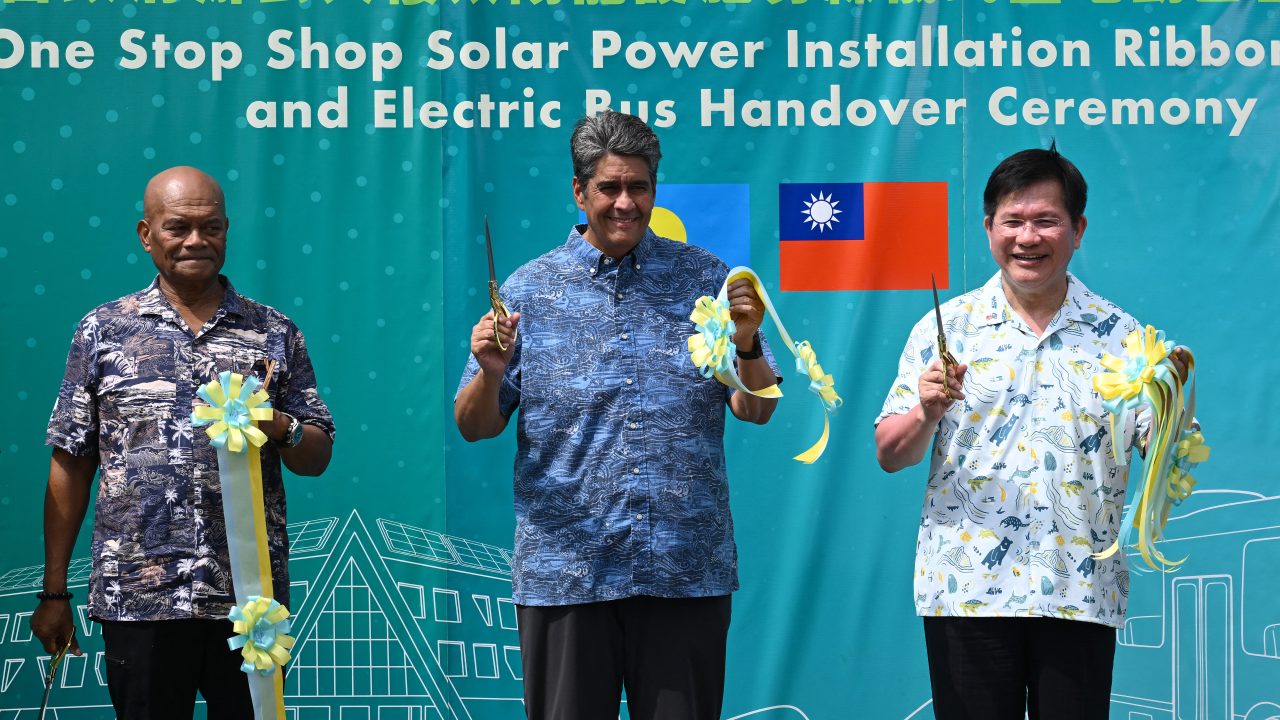
Foreign Minister Lin
Taiwan’s Minister of Foreign Affairs, Lin Chia-lung (林佳龍), visited Palau last week for the annual meeting of the Pacific Islands Forum. Taiwan has traditionally attended the forum as a “development partner,” but since 2024 there has been pressure from Chinese allies, especially the Solomon Islands, to exclude it.
Palau is one of the few countries that still recognizes Taiwan diplomatically. China still attended the forum and said there would be “consequences” over Taiwan’s attendance. Five of the 18 leaders of Pacific Island countries chose not to attend this year, an absence New Zealand Foreign Minister Winston Peters described as “highly suspicious.” Lin called China’s behavior “wolf warrior” diplomacy, bringing back a phrase that was popular during the Covid years.
Before the summit, Lin announced the donation of electric buses to Palau.
Lin also visited Poland and Italy with a trade delegation in June, Lin’s third known trip to Poland in the last two years and second to Italy. Lin gave a speech on supply chain resilience at the Lombardy Regional Council.
KMT Grandees in the U.S.
Two plausible presidential candidates in 2028 for the Chinese Nationalist Party, or KMT, visited the U.S. in June.
Cheng Li-wun (鄭麗文), the party’s chairwoman, who is seen as concerningly pro-China by many U.S. observers, was looking to bolster her image in Washington. The trip went moderately well in cities outside of the capital, even though some of her events were attended by Chinese influence operatives.
But Cheng was dogged by negative headlines in the U.S. capital. She didn’t have a rumored meeting with National Security Council official Matt Tritle. She said she met with eight senators and members of Congress, but after the trip was finished, it emerged that, in at least one instance, a meeting with a senator had instead been with his staff.
Overall, there was nothing to suggest the trip shifted perceptions of Cheng.
Han Kuo-yu (韓國瑜), the speaker of Taiwan’s legislature, led a non-partisan delegation of lawmakers from all three major parties. Taiwan hosted a reception for them on Capitol Hill that was attended by far more U.S. senators and congresspeople, including Nancy Pelosi.
Other Senior KMT Leaders on Maneuvers
Lu Shiow-yen (盧秀燕), the current mayor of Taichung and another likely presidential candidate, went to Europe for 10 days in June, visiting Germany, Austria and Czechia. The trip focused on industrial ties between Taichung and European cities, including Dresden, where TSMC is building a new semiconductor factory.
Taipei Mayor Chiang Wan-an (蔣萬安) visited Singapore in June for the World Cities Summit. The trip gave him the opportunity to meet with heavy hitters from around the world, including London Mayor Sadiq Khan, whom Chiang said he had invited to Taipei.
Deputy Legislative Speaker Johnny Chiang (江啟臣), who is running to succeed Lu as mayor of Taichung, led a non-partisan delegation to Japan in August for the Asian-Pacific Parliamentarians’ Union General Assembly. Chiang also met with a Japanese delegation in Taipei the following week.
Western Politicians in Taiwan
Senator Tammy Duckworth visited Taiwan in July and gave remarks at the Taiwan International Ocean Forum. Domino Theory obtained exclusive access to the itinerary of the senator, who is a relatively frequent visitor to Taiwan, on this trip.
Duckworth was joined on stage by Tom Tugendhat, the British Conservative politician who is a noted and sustained China critic. Tugendhat made his visit to Taiwan as part of a delegation from the Inter-Parliamentary Alliance on China, or IPAC, a multinational group of China-skeptical politicians.
Tugendhat became shadow foreign minister last week, a quasi-official opposition role in the U.K.’s Parliament. His focus on China and Taiwan has continued unabated.
Former Finnish Prime Minister Sanna Marin also visited Taipei in August, speaking at the Ketagalan Forum, one of Taiwan’s annual foreign policy-focused events. Marin’s speech lent heavily on comparisons between Taiwan and Ukraine, but she also pointed out that countries’ “one China” policies could complicate their support for Taiwan in a crisis.
Czech Senate Speaker Milos Vystrcil, whose 2020 visit to Taiwan was the start of a much more active phase in Czech-Taiwanese relations, was back in Taipei in June. The new Czech government criticized his trip, saying it would damage relations with China, and refused to let him use a government plane. “Taiwan and Czechia are both free and democratic countries, and we do not have to obey others’ orders about who we should or should not be friends with,” Vystrcil said, per Formosa News.



Leave a Reply