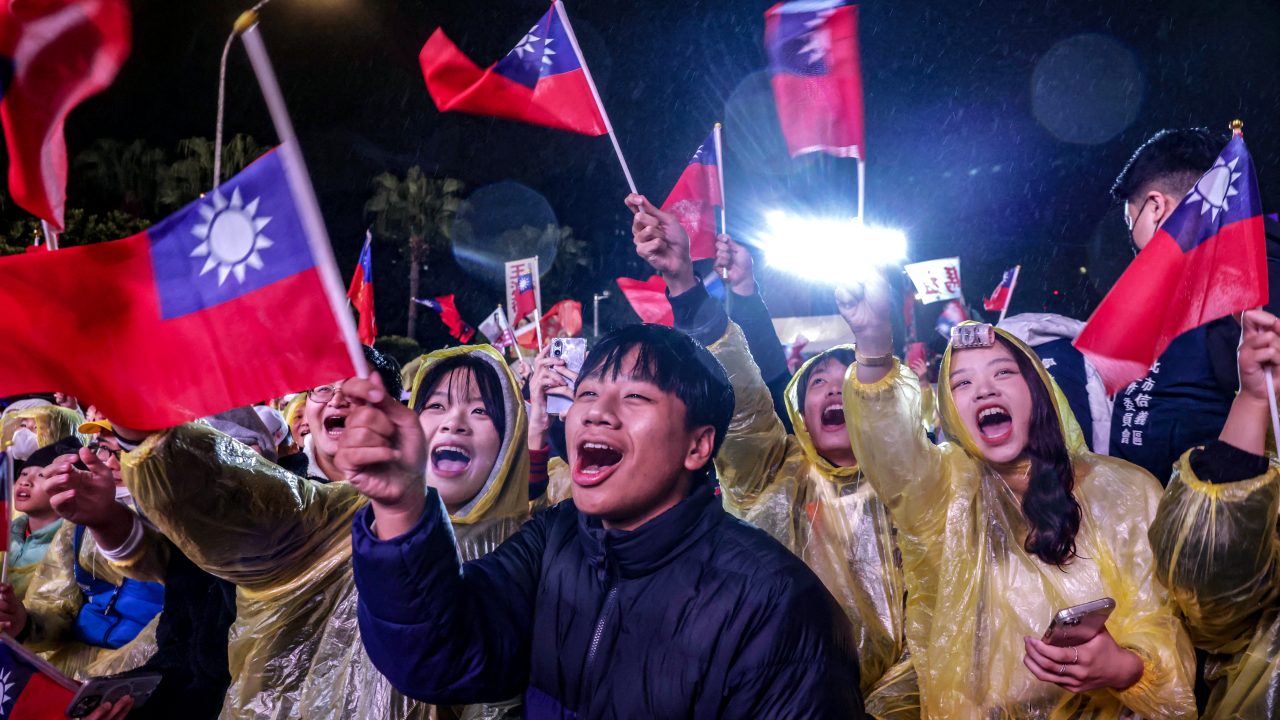
The proportion of people in Taiwan who reject Beijing’s “one China” principle as a precondition for political negotiations across the Taiwan Strait has fallen sharply since 2023, according to a poll released last month by a non-profit in Taiwan comprising cross-strait experts.
The poll, conducted by the Taoyuan National Development Education Foundation, found that 58% of respondents could not accept the principle, down from 72-77% in the four previous surveys conducted from 2019 to 2023. The long-running survey was commissioned by National Taiwan University from 2015 to 2023, before being handed off to the foundation for the 2026 version.
According to Kelly Yang (楊喜慧), an expert in cross-strait relations who helped oversee the poll, the increase in acceptance of the “one China” principle spanned political parties, with the greatest increase being found among independent voters. The portion of these voters who now say they accept the principle was 52.5% in 2026, up from an average of 31.8% in past surveys.
Even among supporters of the ruling Democratic Progressive Party, or DPP, which tends to emphasize Taiwanese identity and staunchly opposes unification with China, support for the “one China” principle is on the rise, with 37.1% saying they could accept it as a basis for cross-strait negotiations, compared with an average of 25.4% in past surveys.
“Previously, academics assumed acceptance of the ‘one China’ principle was related to identity — whether you consider yourself Taiwanese, Chinese or both,” Yang said. But when she ran an analysis, she found no correlation between national identity and perspective on the “one China” principle. “They were completely unrelated,” Yang said. “Whether or not you accept the ‘one China’ principle has nothing to do with whether you identify as Taiwanese or Chinese.”
(According to the latest polling on national identity, just 34% of people who live in Taiwan identify as Chinese, and among those, the vast majority also identify as both Taiwanese and Chinese.)
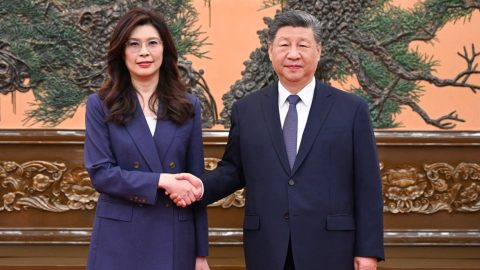
In April, Chairwoman Cheng Li-wun (鄭麗文) of the Kuomintang, or KMT, Taiwan’s main opposition party, traveled to Beijing to meet with China’s leader, Xi Jinping (習近平), making her the first opposition leader to do so in more than a decade. The DPP has never held formal talks with Beijing. Taiwan’s president, Lai Ching-te (賴清德), of the DPP, has said he is open to meeting with Xi, but China has rejected the possibility, referring to Lai as an illegitimate separatist.
The Taoyuan National Development Foundation’s 2026 poll was conducted in May through telephone interviews with adults aged 20 and above in Taiwan. It collected 1,068 valid samples and had a margin of error of plus or minus 3%.
The poll found that 61.6% of people in Taiwan support the idea of cross-strait political negotiations, the lowest rate measured since 2015. Respondents who said they supported negotiations were then asked whether they could accept the “one China” principle as a precondition. They were not asked about their opinions of the principle in general.
The “one China” principle is Beijing’s official stance that there is one China, Taiwan is a part of China and the People’s Republic of China is the sole legitimate government of China. But survey respondents in Taiwan may not interpret the phrase in exactly this way.
The opposition KMT accepts that there is one China and that Taiwan is a part of China, but upholds the Republic of China as the legitimate government. The ruling DPP’s position is that Taiwan does not need to officially declare itself an independent country because it already is one.
However respondents understood the principle, they expressed a significantly greater willingness to accept it than in recent years. Yang says the increase may be due to a sense among Taiwanese people that U.S. support for Taiwan has become less reliable under the second Trump administration.
Back in 2020, Taiwan was the only country in the Asia-Pacific whose citizens preferred Trump to Joe Biden in that year’s presidential election, according to a poll by YouGov. But Biden, at least rhetorically, turned out to be one of the most pro-Taiwan presidents in recent history, saying on multiple occasions that the U.S. military would intervene in the case of a Chinese invasion.
A survey conducted in July 2024 and then again in early 2025 by the Brookings Institution found that Trump’s election victory and the actions his administration took in its first several months had done serious damage to Taiwanese people’s approval of Trump, as well as their faith in the United States more generally.
The rest of Trump’s second term has been a mixed bag. Even as the U.S. government’s actions — and especially those taken by Congress — show a continued desire to bolster Taiwan’s security, Trump’s language has betrayed an openness to reconsidering the status quo that his predecessors avoided. Taiwanese have been especially rattled by Trump’s erratic tariff policies, his repeated insistence that Taiwan “stole” America’s semiconductor industry, and his push to bring Taiwan’s high-end chip manufacturing to the U.S.
Things came to a head last month when Trump said after his summit with Xi that he considers arms sales to Taiwan a “very good negotiating chip” in his dealings with Beijing, a remark that contradicted a longstanding U.S. policy that it would not discuss its military support for Taiwan with the Chinese government. Subsequent assurances from figures like Marco Rubio, the secretary of state, that U.S. policy remains unchanged have done little to calm nerves in Taiwan.
While past inflection points in relations among the United States, Taiwan and China had little impact on Taiwanese acceptance of the “one China” principle, Yang believes Trump’s shifting rhetoric has had a real impact.
In response to Domino Theory’s inquiries, Yang ran “structural break” tests on several geopolitically significant moments over the past decade. 2015-2016 brought the election of the DPP’s Tsai Ing-wen (蔡英文) and a freeze in cross-strait relations; 2019-2020 brought the Hong Kong anti-extradition protests, a significant moment for those who expected Beijing to keep its promises under the “one country, two systems” framework; 2021-2023 brought a surge in Chinese military activity around Taiwan, coinciding with the fallout from Nancy Pelosi’s controversial visit.
“None of those were statistically significant,” Yang said. “Those events didn’t affect the level of acceptance of the ‘one China’ principle. The biggest factor was Trump’s uncertainty. In other words, the perception that the U.S. might no longer strongly support Taiwan caused people to start accepting this negotiation framework.”
A similar statistical analysis on the impact of the United States’ response to Russia’s invasion of Ukraine — viewed by many as a harbinger of America’s willingness to defend Taiwan — showed little immediate impact on Taiwanese views on the “one China” principle.
Chia-hung Tsai (蔡佳泓), a professor at National Chengchi University, said that the rapid growth of China’s military, and its increasingly menacing actions toward Taiwan, may be pushing Taiwanese people toward a more pragmatic approach to cross-strait negotiations, even as they continue to support the DPP in presidential elections.
“One of the possibilities is that Taiwanese people feel threatened by China even though they chose Tsai Ing-wen and William Lai rather than KMT candidates,” Tsai said, referring to Lai Ching-te’s English name. “Therefore, they express their willingness to accept the ‘one China’ principle for negotiation. However, this attitude has not transformed to opposition to the DPP.”
Whether growing acceptance of the “one China” principle has more to do with Trump’s rhetoric or a growing fear of China, it hasn’t affected all age groups equally. The greatest shift toward acceptance of the “one China” principle was found among survey respondents aged 20 to 24, which saw an increase to 42.9% in 2026 from the average of 18.3% across the past decade of surveys. The 60 to 69 age group also saw a significant increase in support for the principle, up to 57.4% from 33.3% across previous surveys. Among Taiwanese citizens in their working primes, the shift was less pronounced.
Taiwan’s government has become increasingly concerned about the influence of Chinese propaganda on social media platforms used widely by young Taiwanese people. Last December, Taiwan’s Interior Ministry imposed a one-year ban on Xiaohongshu, a popular social media platform often described as China’s answer to Instagram. But Chinese influence remains on other popular platforms like TikTok and Threads, the Meta-owned alternative to X that is widely used in Taiwan.
Robert Tsai (蔡季廷), executive director of the Center for China Studies at National Taiwan University, said it was still too early to tell whether the shift in “one China” acceptance was related to online influence.


Leave a Reply